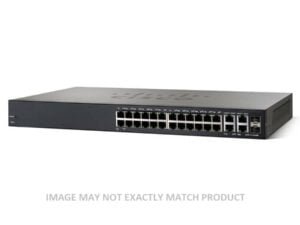
Home / Network Switches / 48 Port (540)
R8Q71A HPE Aruba 6200m Poe 4sfp+ 48-Ports Manageable Rack-mountable Switch.
£5,181.82£6,218.18 Incl. VAT
## Product Overview Of HPE Aruba 48-Ports Rack-mountable Switch The HPE R8Q71A Aruba 6200M is a robust and scalable Layer 3 switch engineered for modern enterprise networks. Featuring 48 high-density PoE access ports and 4 high-speed SFP+ uplink ports, this rack-mountable switch offers exceptional manageability, flexibility, and power efficiency. It is part of Aruba?s 6200M Series, renowned for enhancing access layer performance in campus and branch deployments. With advanced management capabilities and support for Aruba?s AOS-CX operating system, this switch enables secure, simplified, and highly available networking infrastructure. ## Technical Specifications Summary ? Product Number: R8Q71A ? Form Factor: 1U rack-mountable ? Ports: 48 x Gigabit Ethernet PoE+; 4 x SFP+ 10GbE ? Switching Capacity: 176 Gbps ? Forwarding Rate: 130.9 Mpps ? PoE Budget: Up to 740W ? Management: Web GUI, CLI, Aruba Central, REST API ? Routing: Layer 3 with OSPF, Static, VRRP ? Security: MACsec, 802.1X, ACLs, DHCP Snooping ? Stacking: VSX supported ? Power Supply: Modular, hot-swappable ? Cooling: Variable-speed fans, front-to-back airflow Exceptional Switching Power and Throughput ### Performance Highlights ? Robust switching capacity of 272 Gbps ensures smooth data transfers ? Delivers up to 130.9 Mpps for peak packet forwarding performance ? Low latency across speeds: 2.28?s (1G) and 1.46?s (10G) ? 8 MB packet buffer for handling traffic surges and large transfers ? 40 Gbps stacking bandwidth for seamless unit interconnection ## Comprehensive Power and PoE Distribution ### Smart Power Efficiency ? Maximum PoE budget of 1440W to support IP cameras, VoIP phones, and access points ? Power consumption ranges between 59W (idle) and 74W (operational) ? Dual internal power supply support (not pre-installed) ensures redundancy ? Accepts universal AC input: 100?240V at 50/60Hz ## Extensive Management and Security Suite ### Enterprise-Class Remote Access and Authentication ? Supports CLI, SNMP v1/v2c/v3 for simplified remote management ? Integrated web GUI for intuitive configuration and monitoring ? Advanced encryption using SSL, MD5, and FIPS 140-2 compliant algorithms ? AAA support via RADIUS and TACACS+ authentication ### Layer 2/3 Protocols and Multicast Features ? Supports OSPFv2/v3, RIP-2, ECMP for dynamic routing ? Handles 128 switched virtual interfaces (SVIs) ? Unicast routing for IPv4/IPv6 with 2000 route entries each ? Multicast management via IGMP and MLD with support for 1000 groups ## Smart Switching Technology and Traffic Optimization ### Advanced Switching Intelligence ? Layer 2 switching with ARP support, BPDU filtering, and VLAN segmentation ? DiffServ and ToS for traffic prioritization and QoS ? Equal-Cost Multi-Path routing (ECMP) for optimal path utilization ? Jumbo frame support up to 9220 bytes for large packet transfers ### Traffic Shaping and Multicast Optimization ? Deficit Weighted Round Robin (DWRR) queuing and Egress Queue Shaping (EQS) ? Source-Specific Multicast (SSM) and IGMP snooping for efficient broadcast control ? Unidirectional Link Detection (UDLD) enhances link failure detection ## Hardware Expandability and Interface Array ### Port and Connector Options ? RJ-45 console and management ports for local setup ? USB Type-A host interface and USB-C console port ? Hot-swappable modular power supply units supported ? Security slot compatible with Kensington locks for physical protection ## Protocol Standards and Compliance ### IEEE and Industry Standard Certifications ? Meets IEEE standards including 802.3af, 802.3at, 802.3bt for PoE ? Supports link aggregation with 802.3ad (LACP) ? Spanning Tree Protocols: 802.1D, 802.1W, and 802.1S ? LLDP (802.1AB) enabled for device discovery ## Capacity for Large Network Environments ### Table and Entry Limits ? Supports 16,000 MAC address entries for broad client management ? ACL entries per direction (Ingress/Egress): IPv4, IPv6, and MAC types ? Max stack size: Connect up to 8 switches in one logical group ## System Memory and Processing Power ### Embedded Hardware Specifications ? Powered by a 1.8 GHz ARM processor ? 8 GB DDR4 SDRAM for smooth system operations ? Onboard 16 GB flash storage for firmware and configuration files ##### Other Utility Features ? Automatic MDIX for simplified cabling ? Virtual Router Redundancy Protocol (VRRP) for network availability ? Built-in Trusted Platform Module (TPM) for hardware-based security ? Unsupported Transceiver Mode (UTM) alerts for non-compliant modules ? Integrated NTP support for precise time synchronization ### 48-Port Power over Ethernet (PoE) Capability Designed to power IP phones, wireless access points, surveillance cameras, and IoT devices, the switch?s PoE ports support IEEE 802.3af/at standards. These ports can deliver consistent and reliable power directly to connected devices without the need for additional power supplies. With intelligent power allocation, the switch dynamically manages the power budget to ensure optimal energy usage while maintaining full performance. #### Energy-Efficient Design The Aruba 6200M PoE switch incorporates Energy Efficient Ethernet (EEE) standards that help reduce operational costs by lowering energy consumption during periods of low data activity. Its smart fans, thermal sensors, and power-saving features contribute to lower total cost of ownership, making it an environmentally responsible solution. ## Advanced Networking with 4 SFP+ Uplinks Equipped with four 10GbE SFP+ uplink ports, the HPE R8Q71A ensures high-speed connectivity to core networks or aggregation switches. These uplinks offer seamless bandwidth scalability, facilitating aggregation of multiple access switches or direct connection to distribution or core layers. This makes the 6200M suitable for enterprise campus cores or high-density wiring closets. ### High Availability and Redundancy The uplinks support link aggregation and redundant connections, helping maintain network availability even in the event of link or port failure. With intelligent failover mechanisms, traffic is automatically rerouted, ensuring consistent connectivity and minimizing downtime. ## Aruba AOS-CX Operating System and Intelligent Management The switch runs on Aruba?s modern AOS-CX network operating system, which features a distributed architecture for fault isolation and resilience. With an intuitive web GUI, REST APIs, and CLI support, IT administrators gain flexible management options and real-time visibility into the network?s health. ### Aruba Network Analytics Engine (NAE) The integrated Network Analytics Engine (NAE) provides real-time monitoring and advanced analytics. By leveraging telemetry and automated event correlation, NAE helps rapidly identify and resolve issues before they impact business operations. The switch also supports dynamic and automated configuration through RESTful APIs and Python scripting. #### Configuration and Monitoring Administrators can manage configurations with cloud-based Aruba Central or locally via Command-Line Interface (CLI) and Web GUI. The switch supports SNMP, sFlow, NetFlow, and port mirroring for robust monitoring and traffic analysis. ## Layer 3 Switching and Routing Performance The HPE Aruba 6200M delivers enterprise-grade Layer 3 capabilities, including OSPF, static routing, policy-based routing, VRRP, and dynamic segmentation. These features enable the switch to operate efficiently in both large-scale LANs and distributed edge environments. ### Routing Protocol Support The switch includes support for RIP, OSPF, and static routing, enabling the creation of scalable and redundant routing paths. VRRP (Virtual Router Redundancy Protocol) adds failover capabilities by ensuring gateway availability. #### Security with Dynamic Segmentation Aruba?s Dynamic Segmentation technology allows IT teams to apply role-based access controls across wired and wireless networks. It automates traffic segmentation and security policies, ensuring appropriate access for users, devices, and applications regardless of their connection point. ## Robust Security Features The HPE R8Q71A switch enhances network security through 802.1X authentication, DHCP snooping, IP Source Guard, and dynamic ARP inspection. These features protect against spoofing and man-in-the-middle attacks. MACsec (IEEE 802.1AE) encryption provides layer 2 traffic security without compromising performance. ### Access Control and Threat Protection Integrated Access Control Lists (ACLs) and user-role policies help filter and restrict traffic based on security posture, ensuring that only authorized devices communicate across the network. Combined with Aruba ClearPass Policy Manager, IT teams can implement identity-based security measures. #### Secure Management Interfaces Secure access protocols such as SSH, HTTPS, and SNMPv3 ensure that management traffic is encrypted and authenticated. This prevents unauthorized users from gaining access to the switch configuration and data. ## Scalability and Stackable Architecture The Aruba 6200M supports Virtual Switching Extension (VSX), enabling high availability and simplified scalability through switch stacking. This architecture allows multiple switches to operate as a single virtual switch, offering ease of management and enhanced resilience. ### Redundancy Through Multi-Chassis Link Aggregation (MC-LAG) By enabling MC-LAG, the 6200M supports dual-homed topologies that provide seamless failover and link redundancy. This is critical in high-availability environments such as data centers and enterprise backbones. #### Modular Power Supply and Fans The switch?s modular design with hot-swappable power supplies and fans offers additional resilience. This allows for maintenance and hardware replacements without network downtime. ## Flexible Deployment Options Thanks to its 1U rack-mountable form factor, the Aruba 6200M fits seamlessly into standard server racks and network closets. It?s ideal for a wide range of deployments, including: ? Enterprise campus access layers ? Wiring closets in medium to large businesses ? Branch office infrastructure ? IoT and smart building implementations ### Silent Operation and Reduced Noise Levels Despite its high port density and PoE capabilities, the switch is optimized for quiet operation, making it suitable for sound-sensitive environments such as schools, retail locations, or open offices. ### Warranty and Support Services The Aruba 6200M series comes with limited lifetime warranty and optional support services including HPE Foundation Care and Proactive Care. These services offer software updates, expert-level technical support, and hardware replacement to ensure uptime and business continuity. #### Firmware and Software Updates Continuous innovation from Aruba ensures that firmware and OS updates are regularly released. Customers receive ongoing access to new features and bug fixes, helping them maintain peak performance and network security over time. ## Ideal Use Cases for HPE R8Q71A Aruba 6200M Switches The HPE R8Q71A Aruba 6200M switch is tailored for enterprise networks requiring scalable performance, superior PoE capabilities, and simplified management. It excels in: ? High-density access deployments in campuses and headquarters ? Branch office consolidation with simplified network management ? IoT convergence with integrated security and traffic segmentation ? Unified wired and wireless networks leveraging Aruba Central ### Integration with Aruba?s Ecosystem This switch integrates seamlessly with Aruba wireless access points, security gateways, and ClearPass Policy Manager. The end result is a unified wired and wireless solution with automated device onboarding, policy enforcement, and traffic visibility. #### IoT and Edge Readiness Built to support massive device density, the 6200M is future-proof for IoT scalability, device authentication, and automation. It helps enterprises move toward smart building solutions with secure and efficient infrastructure.JL864A HPE Flexfabric 5901AF 48 Ports L3 1U Managed Switch
£2,967.53£3,561.04 Incl. VAT
## HPE FlexFabric 5901af Switch Overview #### General Attributes ? Manufacturer: HPE ? Part Number: JL864A ? Form Factor: 1U rack-mountable chassis ? Device Type: Layer-3 managed Ethernet switch ## Performance Specifications ### Throughput & Latency #### Data Plane Metrics ? Switching capacity: 336 Gbps ? Line-rate forwarding: 250 Mpps ? 1 Gbps port latency: 5 ?s ? 40 Gbps port latency: 1.2 ?s ### Table Capacities #### Routing & MAC Entries ? IPv4 routes: 16 000 entries ? IPv6 routes: 8 000 entries ? MAC address table: 110 000 entries ? Jumbo frame support: up to 9 216 bytes ## Port Configuration & Expansion ### Ethernet Interfaces #### Downlink Connections ##### Gigabit Ports ? 48 ? 10/100/1000 Mbps RJ-45 ports #### Uplink Modules ##### SFP+ & QSFP+ Slots ? 4 ? 1/10 GbE SFP+ cages ? 2 ? 40 GbE QSFP+ cages ### Console & USB Access #### Management Connectors ? 1 ? RJ-45 console port ? 1 ? Mini-USB CLI port ? 1 ? USB Type-A for file transfers ## Power & Thermal Design ### Power Supply Options #### Redundant Architecture ? Internal hot-swappable PSU (optional) ? Up to two modules for 1+1 redundancy ### Airflow & Cooling #### Thermal Management ? Front-to-rear airflow optimized for data halls ? Energy-efficient cooling for continuous operation ## Software Features & Protocol Support ### Layer-3 Routing Protocols ? OSPFv2/v3, BGP-4, ISIS, RIP v1/v2, RIPng, VRRP ? Static IPv4/IPv6 routes ### Layer-2 Switching & Security ? VLAN tagging, Q-in-Q, MSTP, RSTP, STP loop guard ? IGMP snooping, broadcast-storm control ? Link aggregation (LACP), Device Link Detection Protocol ### Management & Access Control #### Remote Management ? SNMP v1/2c/3, Telnet, SSH v2 ? Syslog, NTP, TFTP support #### Authentication & Policies ? RADIUS, TACACS+/TACACS ? ACL enforcement, QoS, CoS ### Advanced Networking Capabilities ? OpenFlow-enabled for SDN integration ? In-service software upgrades (ISSU) ? Zero-Touch Provisioning (ZTP) ## Standards Compliance & Memory ### Protocol & Industry Standards ? IEEE 802.1D/w/s/p/q/ad, IEEE 802.3x/ad/ae/ah/ag ? LLDP (IEEE 802.1AB), Ethernet OAM ### System Memory #### DRAM & Flash ? 2 GB SDRAM for control-plane tasks ? 1 GB flash for firmware and configs ## JL864A FlexFabric 5901AF 48 Ports Switch Overview The JL864A HPE FlexFabric 5901AF 48 Ports 1GBase-T 4XG 2QSFP+ L3 1U Managed Rack-Mountable Switch sits in a category designed for high-density Gigabit Ethernet access with flexible uplink capacity and advanced Layer 3 capabilities. This class of switches is engineered for modern campus edge, aggregation for small to mid-size cores, and server access at the top of rack where a blend of copper 1G connectivity and high-throughput fiber uplinks is essential. With forty-eight RJ-45 1GBase-T access ports, a set of multi-gig or 10-gig?class ?XG? uplinks, and dedicated QSFP+ slots for higher-bandwidth interconnects, the platform enables seamless growth, deterministic performance, and simplified operations in consolidated 1U rack space. Buyers researching this category typically prioritize resilient Layer 2/Layer 3 switching, predictable low latency, comprehensive security controls, robust Quality of Service (QoS), and a management stack that supports both traditional CLI and modern API-driven automation. The JL864A designation within the HPE FlexFabric 5900-series lineage emphasizes balanced feature depth and investment protection?ideal for organizations standardizing on 1G copper user/device access while preparing for faster 10G and 40G links upstream. As a managed rack-mountable switch in a 1U form factor, it optimizes space while providing the power and intelligence demanded by contemporary wired networks. ## Hardware Architecture and Port Mix The central promise of a ?48 Ports 1GBase-T 4XG 2QSFP+? switch is its versatile port composition. Forty-eight copper RJ-45 interfaces provide ubiquitous device reach with PoE/PoE+ support models available in the broader category (buyers should confirm PoE budget needs for phones, access points, or cameras). Complementing these are uplink options typically intended for 10G-class fiber or DAC connections, allowing network designers to aggregate traffic cleanly and scale throughput. The two QSFP+ ports deliver additional headroom for stacking-style links, high-speed trunking, or connectivity to distribution or core layers where bandwidth consolidation matters most. By arranging all this in a 1U rack-mountable chassis, the JL864A category emphasizes high density without sacrificing airflow or access to cabling. The hardware form factor supports cable-management arms, front-to-back ventilation patterns common in data centers, and standardized rails. This ease of installation is crucial in closets and micro-data centers where every rack unit counts and where structured cabling needs to remain neat, labeled, and accessible. ## Layer 2 and Layer 3 Feature Depth A core reason to select the JL864A HPE FlexFabric 5901AF L3 managed switch category is its balance of Layer 2 switching and Layer 3 routing. Typical capabilities include VLAN segmentation with 802.1Q tagging, Spanning Tree variants for loop prevention, link aggregation for higher bandwidth and resiliency, and storm control to protect the fabric from broadcast or multicast bursts. Where the category differentiates itself is in routing functions that move traffic between VLANs at wire speed, enabling routed access designs that offload the core and simplify policy enforcement at the edge. #### Advanced Layer 2 Enhancements ? Multiple Spanning Tree (MSTP) or Rapid STP: Flexibly maps VLANs to spanning-tree instances for optimized path selection and fast recovery. ? Link Aggregation (LACP): Allows active/active bundles toward distribution and server NIC teaming for resilient throughput. ? Loop Protection & UDLD-style Functions: Protects against miswired patch panels or sudden loop conditions caused by unmanaged devices. ? IGMP Snooping & MLD Snooping: Efficiently forwards multicast streams for IPTV, conferencing, and surveillance networks. #### IPv4 and IPv6 Readiness Dual-stack campus designs remain common. A category anchored by the JL864A HPE FlexFabric 5901AF ensures that both IPv4 and IPv6 routing, ACLs, and neighbor discovery security are considered. This supports gradual migrations: devices and applications can adopt IPv6 at their own pace while policy maintains parity. Operations teams benefit from consistent show commands, API endpoints, and telemetry that treat IPv6 as a first-class citizen rather than an afterthought. ## Quality of Service (QoS) The JL864A HPE FlexFabric 5901AF 1U managed switch category provides the QoS scaffolding necessary to prioritize interactive and latency-sensitive traffic while protecting bulk data transfers from starving critical services. As enterprise applications distribute across cloud and on-premises, maintaining consistent markings and queueing behavior across the access, distribution, and core layers keeps user experience stable. ## Use Cases The JL864A HPE FlexFabric 5901AF 48-port 1GBase-T switch category is versatile across many verticals. Its port mix and L3 abilities suit both traditional office networks and specialized environments where deterministic performance, security, and manageability are non-negotiable. Below are representative scenarios where this category excels. ### Campus Access for Knowledge Workers In a typical enterprise building, each floor?s wiring closet must accommodate dozens to hundreds of endpoints. The JL864A category provides 48 copper access ports?the sweet spot for a single rack unit?to onboard PCs, docked laptops, VoIP phones, and printers. Where wireless is prevalent, the uplink capacity handles AP backhaul with headroom for growth. Dynamic VLANs and 802.1X ensure workers and guests are segmented correctly, while QoS maintains crystal-clear voice/video during peak hours. ### Healthcare and Clinical Networks Hospitals and clinics need reliable wired access for EHR terminals, imaging workstations, badge printers, and bedside devices. The L3 segmentation at the access layer allows clinical and guest traffic to remain separate, supporting privacy mandates. The redundant uplink design prevents outages from affecting critical floors, and deterministic QoS helps with real-time telemetry and voice communications used by clinical staff. Port security rules can enforce strict admission for authorized medical equipment. ### Higher Education and Research Universities often have diverse device populations and seasonal surges. Dorms, lecture halls, labs, and libraries all benefit from a 48-port 1G access density with fast uplinks. QoS templates can prioritize lecture capture streams and collaboration tools, while ACLs enforce isolation between student networks and administrative resources. With automation-friendly management, IT can scale consistent policies across dozens of buildings with minimal manual intervention. ### Retail and Branch Aggregation Retail stores and distributed branches frequently need PoS terminals, IP cameras, digital signage, IoT sensors, and corporate endpoints to share the same closet. The JL864A category?s L3 and ACL toolkit helps segment PCI-sensitive systems from general office traffic. Uplinks to SD-WAN or MPLS can be shaped and prioritized for transaction reliability. Multicast management enables synchronized digital signage feeds with minimal bandwidth overhead. ## Designing Networks Architects can leverage the port composition to create topologies that balance cost, simplicity, and performance. Below are practical design patterns for the JL864A class that avoid over-engineering while ensuring straightforward scalability. ### Collapsed Access?Distribution In small or moderate sites, combining access and distribution reduces hardware count and cabling complexity. Use the 4XG uplinks to build port-channels between two JL864A-class switches for redundancy, then use QSFP+ to connect to a core or to an upstream router pair if the site backhaul requires higher throughput. Inter-VLAN routing at the access switches simplifies ACL placement and speeds convergence. ### Traditional Three-Tier Campus For larger campuses, deploy multiple JL864A category switches at the access layer, each dual-homed via 10G-class uplinks to distributed pair(s) at the aggregation layer. The 2?QSFP+ ports provide higher-bandwidth trunks from aggregation to the core, allowing inter-building traffic to traverse oversubscribed links without bottlenecks. Leverage MSTP or link aggregation to ensure active paths and fast failover. ### Top-of-Rack (ToR) With Copper Servers Some server racks still rely on 1G copper NICs for legacy systems or management networks. A JL864A-class 48?1G switch in ToR can consolidate these servers while uplinking via 10G or QSFP+ to the aggregation switches. This keeps management planes segregated and simplifies change windows by isolating legacy applications from the production data plane.R8S96A HPE Aruba 48-Ports Cx 10000-48y6c L3 Gigabit Ethernet Rack-mountable Switch
£7,142.86£8,571.43 Incl. VAT
## Product Overview Of HPE Aruba 48-Ports Rack-mountable Switch The HPE Aruba R8S96A 48-Port Cx 10000-48y6c L3 Managed Switch is a next-generation, enterprise-grade networking solution engineered for modern data centers, large-scale enterprises, and cloud-driven environments. It provides advanced routing capabilities, flexible deployment options, and cutting-edge connectivity speeds. With 48 SFP+/SFP28 ports supporting 1/10/25 Gigabit Ethernet and 6 QSFP+/QSFP28 uplinks for 40/100 Gigabit Ethernet, it delivers unmatched scalability and high-performance aggregation for businesses that demand speed, reliability, and flexibility. ## Technical Specifications #### Key Hardware Highlights ? 48 x SFP+/SFP28 ports (1/10/25GbE) ? 6 x QSFP+/QSFP28 uplink ports (40/100GbE) ? Rack-mountable 1U design ? Redundant hot-swappable power supplies ? Advanced cooling fans for thermal efficiency #### Software Features ? Layer 2 and Layer 3 advanced switching ? Dynamic routing protocols: OSPF, BGP, VRF ? QoS, multicast, and traffic shaping ? Security: ACLs, 802.1X, role-based policies ? Cloud management via Aruba Central High-Speed Port Architecture ? 48 ? 1/10/25 Gigabit Ethernet SFP, SFP+, and SFP28 ports ? 6 ? 40/100 Gigabit QSFP+ and QSFP28 uplinks ? Supports seamless integration with modern data centers and cloud-driven infrastructures ### Enclosure and Cooling Design ? Compact 1U rack-mountable chassis ? Front-to-back airflow system ensures optimal thermal management ? Energy-efficient construction designed for continuous operation ### Switching Power and Throughput ? Switching capacity: 3.6 Tbps ? Latency less than 1.30 microseconds ? Engineered to handle heavy traffic loads in large-scale environments #### Capacity Support ? IPv4 host entries: up to 120,000 ? IPv6 host entries: 52,000 ? Unicast routes: IPv4 (131,072) and IPv6 (32,732) ? Multicast routes: IPv4 (4,094) and IPv6 (4,094) ? IGMP and MLD group memberships: 4,094 each ? MAC address table: 98K entries #### Routing Protocol Compatibility ? Supports OSPF, OSPFv3, and RIP/RIPng ? Multiprotocol BGP and Policy-Based Routing (PBR) ? ECMP load balancing for optimized traffic flows ? Static IPv4 and IPv6 routing ? GRE tunneling support ### Management and Control Features ? Command-line interface (CLI) for direct configuration ? SNMP support for monitoring and automation ? RESTful API for modern network management integration ? Multiple console access options (RJ-45, USB, micro-USB) ? Dedicated RJ-45 LAN management port #### System Resources and Storage ? 32 GB of RAM for processing intensive workloads ? 64 MB flash memory for configurations and updates ? Built-in 64 GB SSD for enhanced performance ##### Expansion & Connectivity Options ? 1 ? Serial RJ-45 interface ? 1 ? USB console port ? 1 ? Micro-USB console port ? 1 ? LAN RJ-45 management interface ## Port Configuration and Connectivity ### 48 x 1/10/25 Gigabit SFP+/SFP28 Ports Designed for versatility, the Aruba R8S96A includes 48 small form-factor pluggable (SFP+/SFP28) slots supporting multiple speeds. These ports offer backward compatibility with older 1GbE optics while also enabling high-speed 25GbE connections. Such a configuration allows IT administrators to create hybrid environments, combining legacy infrastructure with high-bandwidth networks. ### 6 x 40/100 Gigabit QSFP+/QSFP28 Uplinks For backbone connectivity and data center aggregation, the switch includes six uplink ports that support 40GbE and 100GbE speeds. These uplinks make it ideal for large-scale data transfers, inter-switch communication, and seamless integration into high-performance server clusters. ## Performance and Scalability ### High-Bandwidth Architecture The switch?s architecture ensures low latency, non-blocking throughput, and wire-speed performance. With advanced ASIC technology, it can handle demanding workloads such as virtualization, cloud storage, and real-time applications. ### Flexible Scaling for Enterprises Whether deployed in campus core networks or data centers, the Aruba 10000-48y6c switch allows seamless scalability. Administrators can start with a modest deployment and easily expand capacity as requirements grow, without replacing the entire infrastructure. ## Security and Compliance ### Integrated Network Security Security is central to enterprise networking, and the R8S96A integrates multiple protective mechanisms. Features such as Access Control Lists (ACLs), port-based authentication (802.1X), and role-based access controls help prevent unauthorized usage. ### Data Protection Standards The switch is designed with industry-standard encryption and compliance support, enabling organizations to meet regulatory requirements while safeguarding sensitive enterprise and customer data. ## Management and Monitoring ### Intelligent Cloud-Based Management Aruba Central cloud management provides a centralized, intuitive interface for configuring and monitoring the switch. Administrators can gain end-to-end visibility, automate tasks, and apply policies consistently across multiple devices. ### On-Premise Management Options For organizations requiring local control, the switch can also be managed via Aruba AirWave or traditional CLI/GUI interfaces. This flexibility accommodates different IT strategies, from fully cloud-driven to on-premise-only models. ## Energy Efficiency and Sustainability ### Low Power Consumption The R8S96A is engineered with energy-efficient components and intelligent cooling mechanisms, minimizing overall power usage. It supports Energy Efficient Ethernet (EEE) standards to reduce operating costs. ### Eco-Friendly Design HPE Aruba emphasizes sustainability, ensuring the switch is manufactured using environmentally responsible practices. Its long lifecycle and reduced energy footprint contribute to greener IT operations. ## Deployment Scenarios ### Enterprise Campus Networks In large enterprises, the R8S96A can serve as a core or aggregation switch, supporting high-bandwidth connections across multiple floors and departments. Its strong security and routing features make it suitable for distributed teams. ### Data Center Environments With support for 25GbE access ports and 100GbE uplinks, the switch excels in data centers where high-speed east-west and north-south traffic are critical. It can seamlessly connect storage systems, virtualization hosts, and high-performance computing clusters. ### Cloud and Hybrid Workloads Organizations transitioning to hybrid cloud environments can benefit from the Aruba 10000-48y6c?s integration with cloud services. It simplifies multi-cloud connectivity while ensuring traffic is securely routed across platforms. ## Reliability and Uptime ### Redundant Hardware The Aruba R8S96A is equipped with dual power supplies and field-replaceable fan trays. These redundant components minimize downtime and ensure continuous operation, even in the event of hardware failures. ### High Availability Features Features such as link aggregation, hitless software upgrades, and fast failover mechanisms provide enterprises with a resilient network foundation, supporting mission-critical applications without interruption.JL864-61101 HPE Flexfabric 5901AF 48 Ports L3 1U Managed Switch
£2,967.53£3,561.04 Incl. VAT
## HPE FlexFabric 5901af Switch Overview #### General Attributes ? Manufacturer: HPE ? Part Number: JL864-61101 ? Form Factor: 1U rack-mountable chassis ? Device Type: Layer-3 managed Ethernet switch ## Performance Specifications ### Throughput & Latency #### Data Plane Metrics ? Switching capacity: 336 Gbps ? Line-rate forwarding: 250 Mpps ? 1 Gbps port latency: 5 ?s ? 40 Gbps port latency: 1.2 ?s ### Table Capacities #### Routing & MAC Entries ? IPv4 routes: 16 000 entries ? IPv6 routes: 8 000 entries ? MAC address table: 110 000 entries ? Jumbo frame support: up to 9 216 bytes ## Port Configuration & Expansion ### Ethernet Interfaces #### Downlink Connections ##### Gigabit Ports ? 48 ? 10/100/1000 Mbps RJ-45 ports #### Uplink Modules ##### SFP+ & QSFP+ Slots ? 4 ? 1/10 GbE SFP+ cages ? 2 ? 40 GbE QSFP+ cages ### Console & USB Access #### Management Connectors ? 1 ? RJ-45 console port ? 1 ? Mini-USB CLI port ? 1 ? USB Type-A for file transfers ## Power & Thermal Design ### Power Supply Options #### Redundant Architecture ? Internal hot-swappable PSU (optional) ? Up to two modules for 1+1 redundancy ### Airflow & Cooling #### Thermal Management ? Front-to-rear airflow optimized for data halls ? Energy-efficient cooling for continuous operation ## Software Features & Protocol Support ### Layer-3 Routing Protocols ? OSPFv2/v3, BGP-4, ISIS, RIP v1/v2, RIPng, VRRP ? Static IPv4/IPv6 routes ### Layer-2 Switching & Security ? VLAN tagging, Q-in-Q, MSTP, RSTP, STP loop guard ? IGMP snooping, broadcast-storm control ? Link aggregation (LACP), Device Link Detection Protocol ### Management & Access Control #### Remote Management ? SNMP v1/2c/3, Telnet, SSH v2 ? Syslog, NTP, TFTP support #### Authentication & Policies ? RADIUS, TACACS+/TACACS ? ACL enforcement, QoS, CoS ### Advanced Networking Capabilities ? OpenFlow-enabled for SDN integration ? In-service software upgrades (ISSU) ? Zero-Touch Provisioning (ZTP) ## Standards Compliance & Memory ### Protocol & Industry Standards ? IEEE 802.1D/w/s/p/q/ad, IEEE 802.3x/ad/ae/ah/ag ? LLDP (IEEE 802.1AB), Ethernet OAM ### System Memory #### DRAM & Flash ? 2 GB SDRAM for control-plane tasks ? 1 GB flash for firmware and configs ## JL864-61101 FlexFabric 5901AF 48 Ports Switch Overview The JL864-61101 HPE FlexFabric 5901AF 48 Ports 1GBase-T 4XG 2QSFP+ L3 1U Managed Rack-Mountable Switch sits in a category designed for high-density Gigabit Ethernet access with flexible uplink capacity and advanced Layer 3 capabilities. This class of switches is engineered for modern campus edge, aggregation for small to mid-size cores, and server access at the top of rack where a blend of copper 1G connectivity and high-throughput fiber uplinks is essential. With forty-eight RJ-45 1GBase-T access ports, a set of multi-gig or 10-gig?class ?XG? uplinks, and dedicated QSFP+ slots for higher-bandwidth interconnects, the platform enables seamless growth, deterministic performance, and simplified operations in consolidated 1U rack space. Buyers researching this category typically prioritize resilient Layer 2/Layer 3 switching, predictable low latency, comprehensive security controls, robust Quality of Service (QoS), and a management stack that supports both traditional CLI and modern API-driven automation. The JL864-61101 designation within the HPE FlexFabric 5900-series lineage emphasizes balanced feature depth and investment protection?ideal for organizations standardizing on 1G copper user/device access while preparing for faster 10G and 40G links upstream. As a managed rack-mountable switch in a 1U form factor, it optimizes space while providing the power and intelligence demanded by contemporary wired networks. ## Hardware Architecture and Port Mix The central promise of a ?48 Ports 1GBase-T 4XG 2QSFP+? switch is its versatile port composition. Forty-eight copper RJ-45 interfaces provide ubiquitous device reach with PoE/PoE+ support models available in the broader category (buyers should confirm PoE budget needs for phones, access points, or cameras). Complementing these are uplink options typically intended for 10G-class fiber or DAC connections, allowing network designers to aggregate traffic cleanly and scale throughput. The two QSFP+ ports deliver additional headroom for stacking-style links, high-speed trunking, or connectivity to distribution or core layers where bandwidth consolidation matters most. By arranging all this in a 1U rack-mountable chassis, the JL864-61101 category emphasizes high density without sacrificing airflow or access to cabling. The hardware form factor supports cable-management arms, front-to-back ventilation patterns common in data centers, and standardized rails. This ease of installation is crucial in closets and micro-data centers where every rack unit counts and where structured cabling needs to remain neat, labeled, and accessible. ## Layer 2 and Layer 3 Feature Depth A core reason to select the JL864-61101 HPE FlexFabric 5901AF L3 managed switch category is its balance of Layer 2 switching and Layer 3 routing. Typical capabilities include VLAN segmentation with 802.1Q tagging, Spanning Tree variants for loop prevention, link aggregation for higher bandwidth and resiliency, and storm control to protect the fabric from broadcast or multicast bursts. Where the category differentiates itself is in routing functions that move traffic between VLANs at wire speed, enabling routed access designs that offload the core and simplify policy enforcement at the edge. #### Advanced Layer 2 Enhancements ? Multiple Spanning Tree (MSTP) or Rapid STP: Flexibly maps VLANs to spanning-tree instances for optimized path selection and fast recovery. ? Link Aggregation (LACP): Allows active/active bundles toward distribution and server NIC teaming for resilient throughput. ? Loop Protection & UDLD-style Functions: Protects against miswired patch panels or sudden loop conditions caused by unmanaged devices. ? IGMP Snooping & MLD Snooping: Efficiently forwards multicast streams for IPTV, conferencing, and surveillance networks. #### IPv4 and IPv6 Readiness Dual-stack campus designs remain common. A category anchored by the JL864-61101 HPE FlexFabric 5901AF ensures that both IPv4 and IPv6 routing, ACLs, and neighbor discovery security are considered. This supports gradual migrations: devices and applications can adopt IPv6 at their own pace while policy maintains parity. Operations teams benefit from consistent show commands, API endpoints, and telemetry that treat IPv6 as a first-class citizen rather than an afterthought. ## Quality of Service (QoS) The JL864-61101 HPE FlexFabric 5901AF 1U managed switch category provides the QoS scaffolding necessary to prioritize interactive and latency-sensitive traffic while protecting bulk data transfers from starving critical services. As enterprise applications distribute across cloud and on-premises, maintaining consistent markings and queueing behavior across the access, distribution, and core layers keeps user experience stable. ## Use Cases The JL864-61101 HPE FlexFabric 5901AF 48-port 1GBase-T switch category is versatile across many verticals. Its port mix and L3 abilities suit both traditional office networks and specialized environments where deterministic performance, security, and manageability are non-negotiable. Below are representative scenarios where this category excels. ### Campus Access for Knowledge Workers In a typical enterprise building, each floor?s wiring closet must accommodate dozens to hundreds of endpoints. The JL864-61101 category provides 48 copper access ports?the sweet spot for a single rack unit?to onboard PCs, docked laptops, VoIP phones, and printers. Where wireless is prevalent, the uplink capacity handles AP backhaul with headroom for growth. Dynamic VLANs and 802.1X ensure workers and guests are segmented correctly, while QoS maintains crystal-clear voice/video during peak hours. ### Healthcare and Clinical Networks Hospitals and clinics need reliable wired access for EHR terminals, imaging workstations, badge printers, and bedside devices. The L3 segmentation at the access layer allows clinical and guest traffic to remain separate, supporting privacy mandates. The redundant uplink design prevents outages from affecting critical floors, and deterministic QoS helps with real-time telemetry and voice communications used by clinical staff. Port security rules can enforce strict admission for authorized medical equipment. ### Higher Education and Research Universities often have diverse device populations and seasonal surges. Dorms, lecture halls, labs, and libraries all benefit from a 48-port 1G access density with fast uplinks. QoS templates can prioritize lecture capture streams and collaboration tools, while ACLs enforce isolation between student networks and administrative resources. With automation-friendly management, IT can scale consistent policies across dozens of buildings with minimal manual intervention. ### Retail and Branch Aggregation Retail stores and distributed branches frequently need PoS terminals, IP cameras, digital signage, IoT sensors, and corporate endpoints to share the same closet. The JL864-61101 category?s L3 and ACL toolkit helps segment PCI-sensitive systems from general office traffic. Uplinks to SD-WAN or MPLS can be shaped and prioritized for transaction reliability. Multicast management enables synchronized digital signage feeds with minimal bandwidth overhead. ## Designing Networks Architects can leverage the port composition to create topologies that balance cost, simplicity, and performance. Below are practical design patterns for the JL864-61101 class that avoid over-engineering while ensuring straightforward scalability. ### Collapsed Access?Distribution In small or moderate sites, combining access and distribution reduces hardware count and cabling complexity. Use the 4XG uplinks to build port-channels between two JL864-61101-class switches for redundancy, then use QSFP+ to connect to a core or to an upstream router pair if the site backhaul requires higher throughput. Inter-VLAN routing at the access switches simplifies ACL placement and speeds convergence. ### Traditional Three-Tier Campus For larger campuses, deploy multiple JL864-61101 category switches at the access layer, each dual-homed via 10G-class uplinks to distributed pair(s) at the aggregation layer. The 2?QSFP+ ports provide higher-bandwidth trunks from aggregation to the core, allowing inter-building traffic to traverse oversubscribed links without bottlenecks. Leverage MSTP or link aggregation to ensure active paths and fast failover. ### Top-of-Rack (ToR) With Copper Servers Some server racks still rely on 1G copper NICs for legacy systems or management networks. A JL864-61101-class 48?1G switch in ToR can consolidate these servers while uplinking via 10G or QSFP+ to the aggregation switches. This keeps management planes segregated and simplifies change windows by isolating legacy applications from the production data plane.JL864-61001 HPE Flexfabric 5901AF 48 Ports L3 1U Managed Switch
£2,967.53£3,561.04 Incl. VAT
## HPE FlexFabric 5901af Switch Overview #### General Attributes ? Manufacturer: HPE ? Part Number: JL864-61001 ? Form Factor: 1U rack-mountable chassis ? Device Type: Layer-3 managed Ethernet switch ## Performance Specifications ### Throughput & Latency #### Data Plane Metrics ? Switching capacity: 336 Gbps ? Line-rate forwarding: 250 Mpps ? 1 Gbps port latency: 5 ?s ? 40 Gbps port latency: 1.2 ?s ### Table Capacities #### Routing & MAC Entries ? IPv4 routes: 16 000 entries ? IPv6 routes: 8 000 entries ? MAC address table: 110 000 entries ? Jumbo frame support: up to 9 216 bytes ## Port Configuration & Expansion ### Ethernet Interfaces #### Downlink Connections ##### Gigabit Ports ? 48 ? 10/100/1000 Mbps RJ-45 ports #### Uplink Modules ##### SFP+ & QSFP+ Slots ? 4 ? 1/10 GbE SFP+ cages ? 2 ? 40 GbE QSFP+ cages ### Console & USB Access #### Management Connectors ? 1 ? RJ-45 console port ? 1 ? Mini-USB CLI port ? 1 ? USB Type-A for file transfers ## Power & Thermal Design ### Power Supply Options #### Redundant Architecture ? Internal hot-swappable PSU (optional) ? Up to two modules for 1+1 redundancy ### Airflow & Cooling #### Thermal Management ? Front-to-rear airflow optimized for data halls ? Energy-efficient cooling for continuous operation ## Software Features & Protocol Support ### Layer-3 Routing Protocols ? OSPFv2/v3, BGP-4, ISIS, RIP v1/v2, RIPng, VRRP ? Static IPv4/IPv6 routes ### Layer-2 Switching & Security ? VLAN tagging, Q-in-Q, MSTP, RSTP, STP loop guard ? IGMP snooping, broadcast-storm control ? Link aggregation (LACP), Device Link Detection Protocol ### Management & Access Control #### Remote Management ? SNMP v1/2c/3, Telnet, SSH v2 ? Syslog, NTP, TFTP support #### Authentication & Policies ? RADIUS, TACACS+/TACACS ? ACL enforcement, QoS, CoS ### Advanced Networking Capabilities ? OpenFlow-enabled for SDN integration ? In-service software upgrades (ISSU) ? Zero-Touch Provisioning (ZTP) ## Standards Compliance & Memory ### Protocol & Industry Standards ? IEEE 802.1D/w/s/p/q/ad, IEEE 802.3x/ad/ae/ah/ag ? LLDP (IEEE 802.1AB), Ethernet OAM ### System Memory #### DRAM & Flash ? 2 GB SDRAM for control-plane tasks ? 1 GB flash for firmware and configs ## JL864-61001 FlexFabric 5901AF 48 Ports Switch Overview The JL864-61001 HPE FlexFabric 5901AF 48 Ports 1GBase-T 4XG 2QSFP+ L3 1U Managed Rack-Mountable Switch sits in a category designed for high-density Gigabit Ethernet access with flexible uplink capacity and advanced Layer 3 capabilities. This class of switches is engineered for modern campus edge, aggregation for small to mid-size cores, and server access at the top of rack where a blend of copper 1G connectivity and high-throughput fiber uplinks is essential. With forty-eight RJ-45 1GBase-T access ports, a set of multi-gig or 10-gig?class ?XG? uplinks, and dedicated QSFP+ slots for higher-bandwidth interconnects, the platform enables seamless growth, deterministic performance, and simplified operations in consolidated 1U rack space. Buyers researching this category typically prioritize resilient Layer 2/Layer 3 switching, predictable low latency, comprehensive security controls, robust Quality of Service (QoS), and a management stack that supports both traditional CLI and modern API-driven automation. The JL864-61001 designation within the HPE FlexFabric 5900-series lineage emphasizes balanced feature depth and investment protection?ideal for organizations standardizing on 1G copper user/device access while preparing for faster 10G and 40G links upstream. As a managed rack-mountable switch in a 1U form factor, it optimizes space while providing the power and intelligence demanded by contemporary wired networks. ## Hardware Architecture and Port Mix The central promise of a ?48 Ports 1GBase-T 4XG 2QSFP+? switch is its versatile port composition. Forty-eight copper RJ-45 interfaces provide ubiquitous device reach with PoE/PoE+ support models available in the broader category (buyers should confirm PoE budget needs for phones, access points, or cameras). Complementing these are uplink options typically intended for 10G-class fiber or DAC connections, allowing network designers to aggregate traffic cleanly and scale throughput. The two QSFP+ ports deliver additional headroom for stacking-style links, high-speed trunking, or connectivity to distribution or core layers where bandwidth consolidation matters most. By arranging all this in a 1U rack-mountable chassis, the JL864-61001 category emphasizes high density without sacrificing airflow or access to cabling. The hardware form factor supports cable-management arms, front-to-back ventilation patterns common in data centers, and standardized rails. This ease of installation is crucial in closets and micro-data centers where every rack unit counts and where structured cabling needs to remain neat, labeled, and accessible. ## Layer 2 and Layer 3 Feature Depth A core reason to select the JL864-61001 HPE FlexFabric 5901AF L3 managed switch category is its balance of Layer 2 switching and Layer 3 routing. Typical capabilities include VLAN segmentation with 802.1Q tagging, Spanning Tree variants for loop prevention, link aggregation for higher bandwidth and resiliency, and storm control to protect the fabric from broadcast or multicast bursts. Where the category differentiates itself is in routing functions that move traffic between VLANs at wire speed, enabling routed access designs that offload the core and simplify policy enforcement at the edge. #### Advanced Layer 2 Enhancements ? Multiple Spanning Tree (MSTP) or Rapid STP: Flexibly maps VLANs to spanning-tree instances for optimized path selection and fast recovery. ? Link Aggregation (LACP): Allows active/active bundles toward distribution and server NIC teaming for resilient throughput. ? Loop Protection & UDLD-style Functions: Protects against miswired patch panels or sudden loop conditions caused by unmanaged devices. ? IGMP Snooping & MLD Snooping: Efficiently forwards multicast streams for IPTV, conferencing, and surveillance networks. #### IPv4 and IPv6 Readiness Dual-stack campus designs remain common. A category anchored by the JL864-61001 HPE FlexFabric 5901AF ensures that both IPv4 and IPv6 routing, ACLs, and neighbor discovery security are considered. This supports gradual migrations: devices and applications can adopt IPv6 at their own pace while policy maintains parity. Operations teams benefit from consistent show commands, API endpoints, and telemetry that treat IPv6 as a first-class citizen rather than an afterthought. ## Quality of Service (QoS) The JL864-61001 HPE FlexFabric 5901AF 1U managed switch category provides the QoS scaffolding necessary to prioritize interactive and latency-sensitive traffic while protecting bulk data transfers from starving critical services. As enterprise applications distribute across cloud and on-premises, maintaining consistent markings and queueing behavior across the access, distribution, and core layers keeps user experience stable. ## Use Cases The JL864-61001 HPE FlexFabric 5901AF 48-port 1GBase-T switch category is versatile across many verticals. Its port mix and L3 abilities suit both traditional office networks and specialized environments where deterministic performance, security, and manageability are non-negotiable. Below are representative scenarios where this category excels. ### Campus Access for Knowledge Workers In a typical enterprise building, each floor?s wiring closet must accommodate dozens to hundreds of endpoints. The JL864-61001 category provides 48 copper access ports?the sweet spot for a single rack unit?to onboard PCs, docked laptops, VoIP phones, and printers. Where wireless is prevalent, the uplink capacity handles AP backhaul with headroom for growth. Dynamic VLANs and 802.1X ensure workers and guests are segmented correctly, while QoS maintains crystal-clear voice/video during peak hours. ### Healthcare and Clinical Networks Hospitals and clinics need reliable wired access for EHR terminals, imaging workstations, badge printers, and bedside devices. The L3 segmentation at the access layer allows clinical and guest traffic to remain separate, supporting privacy mandates. The redundant uplink design prevents outages from affecting critical floors, and deterministic QoS helps with real-time telemetry and voice communications used by clinical staff. Port security rules can enforce strict admission for authorized medical equipment. ### Higher Education and Research Universities often have diverse device populations and seasonal surges. Dorms, lecture halls, labs, and libraries all benefit from a 48-port 1G access density with fast uplinks. QoS templates can prioritize lecture capture streams and collaboration tools, while ACLs enforce isolation between student networks and administrative resources. With automation-friendly management, IT can scale consistent policies across dozens of buildings with minimal manual intervention. ### Retail and Branch Aggregation Retail stores and distributed branches frequently need PoS terminals, IP cameras, digital signage, IoT sensors, and corporate endpoints to share the same closet. The JL864-61001 category?s L3 and ACL toolkit helps segment PCI-sensitive systems from general office traffic. Uplinks to SD-WAN or MPLS can be shaped and prioritized for transaction reliability. Multicast management enables synchronized digital signage feeds with minimal bandwidth overhead. ## Designing Networks Architects can leverage the port composition to create topologies that balance cost, simplicity, and performance. Below are practical design patterns for the JL864-61001 class that avoid over-engineering while ensuring straightforward scalability. ### Collapsed Access?Distribution In small or moderate sites, combining access and distribution reduces hardware count and cabling complexity. Use the 4XG uplinks to build port-channels between two JL864-61001-class switches for redundancy, then use QSFP+ to connect to a core or to an upstream router pair if the site backhaul requires higher throughput. Inter-VLAN routing at the access switches simplifies ACL placement and speeds convergence. ### Traditional Three-Tier Campus For larger campuses, deploy multiple JL864-61001 category switches at the access layer, each dual-homed via 10G-class uplinks to distributed pair(s) at the aggregation layer. The 2?QSFP+ ports provide higher-bandwidth trunks from aggregation to the core, allowing inter-building traffic to traverse oversubscribed links without bottlenecks. Leverage MSTP or link aggregation to ensure active paths and fast failover. ### Top-of-Rack (ToR) With Copper Servers Some server racks still rely on 1G copper NICs for legacy systems or management networks. A JL864-61001-class 48?1G switch in ToR can consolidate these servers while uplinking via 10G or QSFP+ to the aggregation switches. This keeps management planes segregated and simplifies change windows by isolating legacy applications from the production data plane.R0P81A HPE 48 Ports 25 Gigabit Ethernet 8QSFP28 Airflow Switch.
£4,954.55£5,945.46 Incl. VAT
## Product Overview of HPE R0P81A M-Series SN2410M Switch The HPE R0P81A 48-Port M-Series SN2410M 25GbE Ethernet Switch is designed for enterprise-grade data centers that demand rapid, stable, and cost-efficient connectivity. Offering a balance of scalability, performance, and predictable throughput, it is an outstanding top-of-rack (ToR) networking solution for storage and server infrastructures. With support for multiple port speeds ranging from 1GbE to 100GbE, this platform is future-ready, ensuring seamless adaptability to evolving IT requirements. ## Key Features of HPE R0P81A M-Series SN2410M ? 48-port 25GbE SFP28 with 8-port 100GbE QSFP28 configuration ? Pay-as-you-grow licensing model for flexible scalability ? Wire-speed Layer 2 and Layer 3 capabilities with zero packet loss ? Support for 1/10/25/40/100GbE connectivity ? Ultra-low latency under 300ns, optimized for flash storage performance ? Efficient design that reduces TCO while maximizing ROI ? Hot-swappable power supplies and fan trays for continuous availability ### High-Density Data Center Switching Built as a 1U form factor, the SN2410M offers two powerful configurations: ? 48x 25GbE SFP28 + 8x 100GbE QSFP28 ? 48x 10GbE SFP+ + 8x 100GbE QSFP28 The 100GbE uplink ports can be split into 4x 25GbE or 4x 10GbE channels, delivering tremendous flexibility for a range of enterprise workloads. Customers can start with a 24-port entry-level configuration and expand seamlessly with additional licenses when required. ### Superior Performance and Future-Ready Growth This switch ensures predictable throughput and line-rate performance across all frame sizes and mixed port speeds. With zero packet loss architecture, critical workloads?such as financial transactions, real-time analytics, or storage networking?run reliably without disruption. #### Performance Highlights ? Aggregate bandwidth of 4Tbps ? Consistent throughput across all environments ? Supports heavy workloads without degradation ? Eliminates latency bottlenecks in modern storage systems ### Optimized for Enterprise Storage and Cloud Data Centers The SN2410M switch is engineered with enterprise storage optimization in mind. By offering 10GbE and 25GbE rack-level connectivity combined with 100GbE uplinks, it caters to diverse application-specific blocking ratios while maintaining robust efficiency and cost-effectiveness. #### Enterprise-Level Benefits ? Flexible mix of ports for dynamic infrastructure needs ? Scalable design for hyper-converged environments ? Superior ROI with reduced operational overhead ? High reliability even during mixed traffic workloads ### Enhancing Flash Storage ROI and Performance Designed with ultra-low sub-300ns latency, this switch accelerates flash storage systems by removing networking bottlenecks. The buffering architecture ensures seamless micro-burst absorption, making it ideal for cloud-driven, software-defined, and high-transaction workloads. ## Technical Specifications of HPE R0P81A SN2410M Switch ### Form Factor and Dimensions ? Rack Unit Size: 1U ? Dimensions: 4.39 x 43.8 x 43.6 cm ? Weight: 8.52 kg ### Port and Speed Options ? Supported Speeds: 1Gbps, 10Gbps, 25Gbps, 40Gbps, 100Gbps ? Bandwidth Capacity: 4 Tbps aggregate ? Port Split Options: 100GbE into 4x25GbE or 4x10GbE ### Software and Licensing ? Required Software: Onyx and ONIE ? Optional Licenses: SN2410BM 10GbE 24-Port Upgrade License SN2410M 25GbE 24-Port Upgrade License ? SN2410BM 10GbE 24-Port Upgrade License ? SN2410M 25GbE 24-Port Upgrade License ### Resiliency and Availability ? Hot-swappable power supplies ? Hot-swappable fan trays ? Upgrade license for additional ports ? High reliability for mission-critical workloads ##### Supported Protocols ? Ethernet networking standards ? No built-in encryption support ? Compatible with storage, cloud, and financial environments ## HPE R0P81A SN2410M ? High-Density 25GbE Top-of-Rack Data Center Switch The HPE R0P81A (SN2410M) is a 1U M-Series ToR switch engineered for storage-heavy and high-performance server environments. Designed around a 48x SFP28 (1/10/25GbE) front panel and eight QSFP28 uplinks, the SN2410M SKU balances high port density, low latency, and flexible uplink topologies ? making it an ideal option for modern cloud, virtualization and NVMe-over-fabric deployments. Key hardware and platform traits include a compact 1RU form factor, multi-rate SFP28 ports capable of 1/10/25GbE operation, 8 QSFP28 ports that can operate as 40/50/100GbE uplinks or be broken out to 4x10/25GbE, and SKU variants that include ONIE support and selectable fan/power airflow orientations (Power-to-Connector or Connector-to-Power). ## Models, SKUs and ONIE Options ### Available SKUs & form factors The SN2410M family is offered in multiple SKUs so organizations can pick the right balance of port activation, software options, and airflow orientation for their cabinet. Standard configurations include: ? 48x SFP28 + 8x QSFP28 (25GbE capable) ? full density 1U ToR model. ? 24x SFP28 + 4x QSFP28 ? half-density variant for lower entry cost or smaller racks. ? 10GbE versions (SN2410bM) that use SFP+ for environments where 25GbE is not required. Selected SKUs (including the R0P81A) ship with ONIE (Open Network Install Environment) pre-installed so you can boot and install a compatible third-party network OS (NOS) should your deployment require an alternate network operating system. For ONIE SKUs, transceiver and cable support depends on the NOS you choose to load. ### Airflow and data center cooling compatibility HPE offers the SN2410M with different airflow orientations: "Power-to-Connector" and "Connector-to-Power" (sometimes described as power-side to port-side or port-side intake/exhaust). These choices let you align switch airflow with your rack/cold-aisle strategy (front-to-back vs back-to-front), which is essential when mixing equipment from multiple vendors or using hot/cold aisle containment. Ensure all devices in a given rack row share the same airflow orientation to avoid hot-spotting and to maximize cooling efficiency. ## Performance, Latency and Forwarding Characteristics ### Wire-rate forwarding and ultra-low latency The SN2410M family is built for predictable, line-rate performance. The architecture delivers cut-through forwarding that keeps port-to-port latency extremely low (typically under 300 nanoseconds), enabling storage and high-frequency workloads to avoid network-side latency bottlenecks. This low latency and deterministic forwarding is especially important for flash storage, NVMe, HCI clusters, and financial workloads where microseconds matter. ### Switching capacity and forwarding rate Architected to support simultaneous line-rate traffic on all ports, the SN2410M offers multi-terabit internal switching capacity with enough fabric to avoid head-of-line blocking. That translates to sustained throughput across L2 and L3 use cases and zero packet loss at line rate when correctly configured ? a critical guarantee for storage replication, backup windows, and east-west traffic in virtualized fabrics. ## Ports, Breakout Flexibility and Cabling Strategies ### SFP28 ports: multi-rate and use cases The front panel SFP28 connectors support 1/10/25GbE optics and DAC cables, allowing operators to right-size server links based on NIC speed and budget. Use 25GbE links for high-performance hosts and NVMe arrays, 10GbE for legacy or mid-tier servers, and 1GbE where needed for management or edge devices. ### QSFP28 uplinks and breakout options The eight QSFP28 ports provide flexible uplink capacity. Each QSFP28 can operate as a single 100GbE link or be broken out into 4x25GbE (or 4x10GbE) with breakout cables, giving you a wide range of blocking ratios and fabric topologies ? from oversubscribed aggregation fabrics to nearly non-blocking leaf-spine designs. Note that when an odd-numbered QSFP28 port is configured in an x4 breakout, it may unmap the adjacent even numbered QSFP port; always verify breakout implications when planning port layouts. ### Cable and transceiver guidance ? For short runs within racks, consider SFP28 passive or active DACs for lower latency and lower per-port cost. ? For longer or multi-rack uplinks, use SFP28 optical transceivers (LR/ER variants) with single-mode fiber and appropriate MPO/LC patching. ? When breaking out QSFP28, use vendor-approved breakout cables and observe the recommended port mapping rules to avoid accidental disablement of neighboring ports. ## Software, Management and Automation ### HPE Onyx and ONIE flexibility HPE M-Series switches commonly ship with HPE Onyx (or support ONIE on specific SKUs). Onyx brings a full set of enterprise L2/L3 features including advanced telemetry, DCB (for storage/CNA use), and integrated container support for running management tools as dockerized services on the switch. ONIE SKUs allow operators to install alternate NOS images for environments standardizing on third-party network software. When using an ONIE SKU, check the chosen NOS documentation for supported optics and transceivers. ### Automation & orchestration SN2410M integrates with modern data center automation stacks: Zero Touch Provisioning (ZTP), Ansible modules, SaltStack, Puppet and the HPE Network Orchestrator/NEO platform. These tools reduce manual configuration, enforce consistent templates across large deployments, and accelerate provisioning of leaf and spine fabrics. The switch also supports CLI, SSH, JSON/REST and web UI for hybrid human/automation workflows. ### Telemetry and troubleshooting M-Series includes advanced telemetry capabilities such as sampling histograms, link diagnostics, signal degradation monitoring, and the "What Just Happened" (WJH) feature which can inspect packets at line-rate to highlight data-plane anomalies. These tools are valuable for rapid RMA validation, debugging complex multi-tenant fabrics, and RCA in storage replication incidents. ## Security, Access Control and Compliance ### Authentication & role management The SN2410M offers enterprise grade access control with TACACS+, RADIUS, LDAP integration and multiple privilege levels for operator accounts. Use role segmentation, SSH key management and strong cipher suites to protect the control plane in multi-admin environments. ### Data center security features ? 802.1X port-based access control to authenticate servers and switches at the port level. ? ACLs (L2-L4) and CoPP to protect devices from amplification and misconfiguration. ? System Secure Mode and FIPS alignment options for higher compliance needs (when needed and applicable). ## Power, Thermal and Physical Installation ### Power supplies & energy efficiency The SN2410M was engineered to be power efficient ? HPE quotes industry-leading low watts per port to reduce rack heat and operational costs. Lower per-port power draw reduces cooling overhead and is especially relevant in dense ToR deployments where rack power and cooling budgets are constrained. Always check the specific SKU (AC vs DC, single vs dual PSUs) for exact power consumption figures prior to procurement. ### Fans and airflow best practices The SN2410M uses multiple fan modules and its airflow variant (Power-to-Connector or Connector-to-Power) must be matched across the rack. Fan redundancy and monitoring are built in; however, mixing airflow directions in the same aisle can lead to inefficient cooling and higher ambient temperatures. HPE fan & PSU modules are color coded for airflow direction ? replace with like-for-like parts when changing fans or PSUs. ### Rack mounting and physical considerations ? Standard 1U fixed rack mount brackets are included with the switch. ? Allow recommended front and rear clearances for cabling and airflow; review the QuickSpecs for exact dimensions and cable bend radii. ? Plan cable management for QSFP28 breakout cables to prevent strain on ports and to preserve optical performance over time. ## Use Cases and Deployment Patterns ### Top-of-Rack (ToR) leaf switch for scale-out architectures SN2410M excels as a ToR leaf connecting server racks to a spine layer. With 48x 25GbE server ports and QSFP28 uplinks, it supports dense host connectivity and flexible oversubscription strategies between leaf and spine. Pair with 100GbE (or 200/400GbE) spine devices depending on fabric bandwidth requirements. ### Storage networks and NVMe-over-Fabric For storage arrays and NVMe deployments, low latency and deterministic QoS features (DCB, PFC, ECN) are crucial. SN2410M supports the data center bridging stack and prioritization tools needed to reduce packet loss and maintain storage SLA consistency during heavy IO bursts. The native low latency and cut-through forwarding profile make it an attractive choice for flash-first designs. ### Cloud, virtualization and multi-tenant data centers In cloud or shared environments, the SN2410M provides the dense host ports, MLAG/LAG configurations, VLAN/QinQ segmentation, and telemetry required for tenant isolation and performance visibility. Its integration with automation ecosystems (Ansible, ZTP, Puppet) reduces manual template drift during scale out operations. ## Compatibility, Accessories and Upgrades ### Transceivers, breakout cables and SFP28 support Use HPE-qualified transceivers and breakout cables for best interoperability and supportability. When using ONIE SKUs with third-party NOS images, confirm optics compatibility with that NOS documentation ? HPE notes that the transceiver support for ONIE SKUs depends on the installed NOS. Always adhere to vendor-tested optical lists for production environments. ### License upgrades and pay-as-you-grow options The M-Series supports capacity activation and port upgrades via license keys for certain half-density models. This "pay as you grow" licensing allows organizations to buy lower entry SKUs and unlock additional ports or features later ? a useful model for staged deployments or budget-constrained rollouts. ### Maintenance, support and spares ? HPE provides standard support options and field replaceable units (fans, PSUs) for rapid recovery. ? Keep a small stock of vendor-approved spare optics and replacement fan trays or PSUs that match airflow orientation. ? For regulated environments, consult HPE documentation for TAA-compliant SKUs and validated cryptographic modes. ## Comparison & Procurement Considerations ### How SN2410M compares to other leaf switches The SN2410M competes in the dense 25GbE leaf market by offering: ? High SFP28 port density (48 ports) in a single 1U chassis ? excellent for rack-level consolidation. ? Flexible QSFP28 uplinks with breakout capability for adaptable aggregation strategies. ? ONIE options for organizations that require third-party NOS flexibility. ? Low per-port power consumption and sub-microsecond latency for storage and real-time workloads. :contentReference[oaicite:13]{index=13} ### Procurement checklist ? Confirm port speed requirements: do your servers need 25GbE NICs or will 10GbE suffice? ? Decide on ONIE vs. vendor NOS ? ONIE enables alternative NOS but requires you to manage NOS support and optics compatibility. ? Choose airflow orientation to match your rack/aisle design (Power-to-Connector vs Connector-to-Power). ? Plan uplink architecture (100GbE spine, 40/50GbE options, breakout planning) and cable inventory. ? Verify licensing strategy for possible port activation upgrades and software features. ## Content Blocks for Indexing & SEO (Keyword-rich snippets) ### Product keyword focus Use these searchable phrases and long-tail descriptors in meta descriptions and category tags to improve organic visibility: HPE R0P81A, HPE SN2410M, 48 Ports 25GbE SFP28, 8 QSFP28 uplinks, ONIE switch, Power to Connector Airflow, 1U Top-of-Rack leaf switch, NVMe-ready switch, and low latency 25GbE switch. ### Suggested semantic keywords ? ToR leaf switch 25GbE ? SN2410M 48x SFP28 ? QSFP28 breakout 4x25G ? ONIE install environment ? cut-through low latency switching ? data center DCB & PFC ### Structured data hints for category pages Consider exposing structured data (JSON-LD) for the product family: include aggregateRating, vendor (Hewlett Packard Enterprise), modelAliases (R0P81A, Q2F22A, Q6M27A for other variants), keyFeatures (48x SFP28, 8x QSFP28, ONIE support, 1U), and SKU level availability. This helps search engines better identify the product family and improves rich result eligibility.JL428A HPE Aruba 3810m 48g Poe+ 4sfp+ 680w Switch 48 Ports Managed Rack-mountable
£538.96£646.75 Incl. VAT
## HPE JL428A Aruba 3810m 48-Port PoE+ Managed Switch Overview The HPE JL428A Aruba 3810m 48G PoE+ 4SFP+ 680W Switch is a powerful, fully managed switch designed for enterprise-level networking. Offering 48 Gigabit Ethernet ports with Power over Ethernet Plus (PoE+), this switch is ideal for powering network devices such as IP phones, wireless access points, and cameras, all while providing robust performance and scalability. With four SFP+ ports, the Aruba 3810m supports high-speed uplinks for demanding applications, making it suitable for high-density, mission-critical environments. ### Key Specifications of the HPE Aruba 3810m Switch ? Device Type: Managed Stackable Switch with 48 Ports ? Form Factor: Rack-mountable 1U ? Subtype: Gigabit Ethernet ? Ports: 48 x 10/100/1000 (PoE+ enabled) ? Power over Ethernet: PoE+ for efficient power delivery ### Performance and Throughput Details ? Latency: 1000Base-T: 2.8 microseconds 10 Gbps: 1.8 microseconds 40 Gbps: 1.5 microseconds ? 1000Base-T: 2.8 microseconds ? 10 Gbps: 1.8 microseconds ? 40 Gbps: 1.5 microseconds ? Throughput: Up to 190.5 Mpps (64-byte packet size) ? Routing and Switching Capacity: 320 Gbps ? Switching Fabric Bandwidth: 338 Gbps ### Routing and Table Capacity ? IPv4 Routing Table: 10,000 entries ? IPv6 Routing Table: 5,000 entries ? MAC Address Table: 64,000 entries ? Jumbo Frame Support: Yes ### Routing Protocols and Features ? Supported Routing Protocols: OSPF, RIP, BGP, VRRP, and more ? Static Routing: IPv4 & IPv6 static routing options ? Advanced Protocols: BFD, MPLS, OpenFlow, and ICMP #### Remote Management Protocols ? SNMP: SNMP v1, v2c, v3 ? Remote Monitoring: RMON v1, v2, v3, and v9 ? SSH: Secure Shell v2, Telnet, HTTP/S ? Management Access: CLI, Xrmon, Micro-USB #### Security and Authentication ? Encryption: SSL for secure data transmission ? Authentication Methods: RADIUS, TACACS+, SSH2 ? Access Control: ACL and STP support ### Compliant Standards and Protocols ? IEEE 802.3af, 802.3at (PoE), 802.1p, 802.3ad (LACP) ? IEEE 802.1x, 802.1s (Multiple Spanning Tree) ? IEEE 802.1ab (LLDP), 802.3u (Fast Ethernet) ? IEEE 802.1v, 802.11n, and other advanced standards ### Hardware and Expansion Features ? Processor: Dual-core CPU for enhanced performance ? RAM: 6 GB DDR3 SDRAM ? Flash Memory: 1 GB for efficient data storage ? Expansion Slots: 1 free expansion slot, 1 free stacking module slot #### Connectivity Interfaces ? 48 x 1000Base-T (RJ-45) with PoE+ support ? 1 x Console Port (RJ-45) for management access ? 1 x Micro-USB Type B for additional connectivity ### Power and Energy Efficiency ? Power Supply: Internal, hot-plug support ? Power Redundancy: 1+1 optional redundant power supply ? Power Consumption: 680 watts ? Voltage: DC 54V required ? Energy Star Certification: Yes, energy-efficient operation ### Additional Features and Capabilities ? Advanced Layer 3 Switching: Full L3 management for routing and VLAN configurations ? VLAN Support: Dynamic VLAN and GVRP support ? Quality of Service: QoS features to prioritize network traffic ? Link Redundancy: Supports UDLD, and Link Aggregation for improved uptime ## Key Features of the HPE JL428A Aruba 3810m Switch ### High-Performance Connectivity Equipped with 48 Gigabit Ethernet ports, the HPE JL428A Aruba 3810m delivers high-speed connectivity for a wide variety of networked devices. This ensures seamless data transfer for enterprise applications, VoIP communications, and video streaming. The switch also offers Layer 3 routing capabilities, which allow it to route traffic efficiently across different VLANs (Virtual Local Area Networks). ### Power over Ethernet Plus (PoE+) One of the standout features of the HPE JL428A is its support for Power over Ethernet Plus (PoE+), which allows for up to 30 watts of power per port. This eliminates the need for separate power sources for connected devices, reducing cable clutter and simplifying the overall network setup. Devices such as IP cameras, phones, and wireless access points can be powered directly through the Ethernet cable, ensuring a more streamlined and efficient installation. ### 4 x SFP+ Ports for High-Speed Uplinks With four SFP+ ports, the Aruba 3810m offers high-speed fiber optic connectivity for uplinks to core switches or other parts of the network. These 10Gbps SFP+ ports ensure the switch can handle demanding workloads and traffic spikes, supporting high-bandwidth applications such as data backup, server communications, and large-scale video conferencing. ### Scalability and Redundancy The Aruba 3810m switch supports stacking, enabling you to combine multiple units into a single virtual device for increased scalability and redundancy. Stacking reduces the complexity of managing individual switches while increasing the available bandwidth across the network. Redundancy features such as dual power supplies and fan modules ensure uninterrupted performance, even during hardware failures. ### Rack-Mountable Design The HPE JL428A is designed for easy installation in a 19-inch standard rack, making it an ideal solution for organizations with limited space or a need for a more centralized network infrastructure. Its compact, 1U form factor ensures that it fits neatly into server racks, optimizing available space without compromising on performance. ## Advanced Security Features of the HPE Aruba 3810m Switch ### Role-Based Access Control (RBAC) The HPE JL428A Aruba 3810m provides advanced security features such as Role-Based Access Control (RBAC), which allows administrators to define and enforce access permissions for different users based on their role within the network. This granular control over network access ensures that sensitive data and critical resources are protected from unauthorized access. ### Network Segmentation with VLANs Virtual Local Area Networks (VLANs) are a powerful feature of the Aruba 3810m, allowing the network to be segmented into smaller, more manageable sections. VLANs provide improved security by limiting broadcast traffic and isolating sensitive data from the rest of the network. By logically grouping devices into VLANs, organizations can enhance their network security and performance. ### Aruba ClearPass Integration For organizations requiring advanced network security, the Aruba 3810m integrates seamlessly with Aruba ClearPass. This policy management platform provides centralized control over device authentication and authorization, enabling administrators to enforce security policies for both wired and wireless devices across the network. ### Dynamic ARP Inspection and DHCP Snooping To protect against common network attacks, the Aruba 3810m offers Dynamic ARP Inspection (DAI) and DHCP Snooping. These features prevent man-in-the-middle attacks and unauthorized DHCP servers from compromising the network, ensuring that traffic is routed securely and accurately. ## Performance and Reliability of the Aruba 3810m Switch ### High Throughput for Data-Intensive Applications Whether supporting video conferencing, large-scale data backups, or high-bandwidth applications like cloud services, the Aruba 3810m is built to handle intense workloads. With support for 10GbE uplinks via SFP+ ports, the switch is capable of maintaining high throughput even during peak traffic conditions, making it an excellent choice for businesses with demanding network needs. ### Resilient and Fault-Tolerant Network Design The HPE Aruba 3810m offers a number of features that enhance the resilience of your network. Dual power supplies and hot-swappable fan modules ensure that the switch remains operational even in the event of component failure. Additionally, the stackable design allows for automatic failover, ensuring that traffic can continue to flow seamlessly without disruption. ### Comprehensive Monitoring and Troubleshooting Tools To ensure optimal performance, the Aruba 3810m includes a variety of monitoring and troubleshooting tools. These include SNMP (Simple Network Management Protocol) for network monitoring, as well as built-in diagnostic tools for quick detection of faults. The switch also supports the Aruba AirWave platform for advanced network analytics and troubleshooting capabilities, helping IT teams proactively manage the network and resolve issues before they impact operations. ## Management and Configuration Options for the HPE Aruba 3810m ### Web-Based GUI for Easy Management The HPE JL428A Aruba 3810m is equipped with an intuitive, web-based graphical user interface (GUI) that allows administrators to easily configure and manage the switch. The user-friendly interface streamlines the process of setting up network parameters, security settings, and performance optimization options, even for users with limited networking experience. ### Command Line Interface (CLI) for Advanced Users For experienced network administrators, the Aruba 3810m also provides a robust Command Line Interface (CLI) for advanced configuration and troubleshooting. The CLI allows administrators to take full control of the switch, configure VLANs, manage PoE settings, and monitor network traffic with greater flexibility and precision. ### Integration with Aruba Central For cloud-based management, the HPE JL428A can be integrated with Aruba Central, a comprehensive network management solution. Aruba Central provides a centralized platform for monitoring and managing Aruba devices across multiple locations, simplifying the management of large and distributed networks. ### Automated Configuration with Aruba Instant On For smaller networks or businesses looking for an easy setup process, the Aruba 3810m can be paired with Aruba Instant On, which offers automated configuration and deployment. This simplifies the process of deploying new switches and ensuring they are correctly configured for optimal performance in the network. ## Energy Efficiency and Sustainability ### Low Power Consumption The HPE Aruba 3810m is designed with energy efficiency in mind. It features an energy-efficient architecture that helps reduce the overall power consumption of the switch. With support for Energy Efficient Ethernet (EEE), the switch automatically adjusts its power usage based on traffic load, helping organizations reduce energy costs while minimizing their environmental footprint. ### Environmentally Friendly Materials HPE is committed to sustainability, and the Aruba 3810m switch is manufactured using environmentally friendly materials. The switch meets various environmental certifications, including RoHS (Restriction of Hazardous Substances), ensuring that it complies with global environmental standards. ### Fanless Operation for Noise Reduction In environments where noise levels are a concern, the Aruba 3810m's fanless operation is an ideal feature. The switch operates silently, making it suitable for office spaces, retail environments, and other noise-sensitive areas.JL479A HPE Aruba 8320 48-Port 10G SFP+ 6-Port 40G QSFP+ Switch
£7,988.31£9,585.97 Incl. VAT
## Product Overview Of HPE JL479A The HPE JL479A Aruba 8320 is a cutting-edge Layer 3 managed switch, designed to provide robust connectivity and exceptional performance. This rack-mountable device is equipped with 48 10 Gigabit SFP+ ports and 6 40 Gigabit QSFP+ ports, making it ideal for high-demand networking environments. ### Key Specifications ? Device Type: Managed Layer 3 Switch with 48 ports ? Enclosure: Rack-mountable, 1U form factor ? Port Types: 48 x 10 Gigabit SFP+ & 6 x 40 Gigabit QSFP+ ? Switching Capacity: 2.5 Tbps ? Forwarding Performance: 1.905 million packets per second (Mpps) ? VLAN Support: Up to 4096 virtual interfaces (802.1Q) ? Jumbo Frame Capability: Supports frames up to 9 KB #### Routing Protocols ? OSPF ? IGMPv2 & IGMPv3 ? VRRP ? GRE ? Static IPv6 Routing ? ECMP #### Management and Security Features ? Remote Management: SNMP, RMON, TFTP, SFTP ? Encryption Standards: FIPS 140-2 compliant ? Authentication Protocols: RADIUS, TACACS+, SSHv2 ### Advanced Features ? VPN and IPv6 support ? Enhanced monitoring with sFlow ? Spanning Tree Protocol support (STP, RSTP, MSTP) ? Quality of Service (QoS) management ? Link Aggregation Control Protocol (LACP) ? Multi-Chassis Link Aggregation (MLAG) ? Protocol Independent Multicast (PIM) ? Packet storm protection ? Hot-swappable fan redundancy #### Compliance and Standards ? IEEE 802.3z ? IEEE 802.1d, 802.1q, 802.1p, 802.1w ? IEEE 802.3ae, 802.3ad (LACP), 802.1s, 802.1t, 802.1ax ? IEEE 802.1ab (LLDP), 802.1ak, 802.3ba ### Connectivity Options #### Interfaces ? 48 x 10 Gbit SFP+ ports ? 6 x 40 Gbit QSFP+ ports ? 1 x Serial RJ-45 interface ? 1 x Micro-USB console port ? 1 x RJ-45 console port ### Power Specifications ? Power Source: Internal power supply with hot-plug capability ? Installed Units: 2 ? Maximum Units Supported: 2 ? Power Redundancy: Yes (1+1 scheme) ? Total Power Output: 400 Watts ? Voltage Requirements: AC 120/230 V (50/60 Hz) HPE Aruba 8320 JL479A 48-Port 10G SFP+ and 6-Port 40G QSFP+ L3 Managed Rack-mountable Switch ## Ports The HPE Aruba JL479A Switch is equipped with an impressive array of ports, making it a versatile and reliable solution for businesses of all sizes. With a total of 48 ports, including 6 uplink ports, this switch offers exceptional connectivity options to meet the demands of modern networking environments. ### Enhanced Connectivity Having 48 ports allows the HPE Aruba JL479A Switch to accommodate a large number of devices simultaneously. This is especially valuable for organizations with multiple departments or large teams that require a reliable and stable network connection. Each port can be used to connect devices such as computers, printers, servers, and IP phones, ensuring seamless communication and data sharing across the network. ### Flexibility and Scalability The 48 ports on the HPE Aruba JL479A Switch provide businesses with the flexibility to expand their network infrastructure as their needs grow. With ample ports available, adding new devices or expanding the network becomes a straightforward process. This scalability feature makes the switch an ideal choice for both small businesses and larger enterprises. ### Uplink Ports In addition to the 48 standard ports, the HPE Aruba JL479A Switch also features 6 uplink ports. These uplink ports offer higher bandwidth capabilities and can be used to connect the switch to other switches or network devices. The uplink ports enable faster data transfer rates and improve network performance, ensuring smooth and efficient communication between multiple switches or devices. #### Improved Network Performance The inclusion of 6 uplink ports on the HPE Aruba JL479A Switch significantly enhances network performance. These ports support advanced features such as link aggregation, which allows multiple uplink ports to be combined to form a single logical link. This aggregation increases overall bandwidth and provides redundancy in case of a link failure. With link aggregation, businesses can achieve higher throughput and improved network resilience. #### Increased Network Capacity The 6 uplink ports on the HPE Aruba JL479A Switch offer increased network capacity, enabling businesses to handle higher volumes of data traffic. This is particularly beneficial in environments where data-intensive applications and multimedia content are prevalent. The additional uplink ports provide the necessary bandwidth to accommodate the increased data flow, ensuring a smooth and uninterrupted user experience. ### Importance of 48, 6 Ports The number and type of ports on a network switch play a crucial role in determining its usability and effectiveness. The HPE Aruba JL479A Switch's 48 standard ports provide ample connectivity options for various devices within an organization. This ensures that every device can be connected to the network without any limitations, promoting seamless communication and data exchange. Furthermore, the inclusion of 6 uplink ports is highly valuable for businesses seeking to optimize their network performance. These uplink ports offer advanced features such as link aggregation, which enhance network capabilities and provide additional redundancy. The ability to aggregate multiple uplink ports allows businesses to maximize their bandwidth utilization and improve overall network efficiency. The 48, 6 configuration of the HPE Aruba JL479A Switch is especially beneficial for organizations that require a scalable solution. With 48 standard ports, businesses have the flexibility to connect a wide range of devices and accommodate future growth. The 6 uplink ports further enhance scalability by offering increased network capacity and performance capabilities. In conclusion, the HPE Aruba JL479A Switch's 48 standard ports and 6 uplink ports provide users with enhanced connectivity, flexibility, scalability, improved network performance, and increased network capacity. This configuration ensures that businesses can effectively manage their network infrastructure, meet growing demands, and maintain reliable and efficient communication across their organization. Whether it's for small businesses or large enterprises, the HPE Aruba JL479A Switch's ports feature is an essential component for building a robust and future-proofed network environment.JL581A HPE Aruba 48 Ports – Switch L3 Managed 48 X 1 Gigabit Rack-mountable
£6,785.71£8,142.85 Incl. VAT
## Product Overview for the HPE JL581A Aruba 48 Ports - Switch L3 Managed ### Robust Network Architecture Support ? Equipped with 48 ports supporting both 1G and 10G Ethernet connections for flexible deployment. ? Includes 6 QSFP+ ports supporting 40G throughput for high-bandwidth aggregation links. ? Layer 3 managed switch ideal for enterprise core or aggregation layers. ? Advanced routing protocols supported: OSPF, VRRP, ECMP, and static IPv6 routing. Summary of Technical Specifications ? Model Number: JL581A ? Ports: 48 x 1G RJ-45, 6 x 40G QSFP+ ? Switching Capacity: Up to 1.44 Tbps ? Form Factor: 1U Rack-Mountable ? Cooling: X472 Fan Tray with 5 Fans ? Power: Dual Hot-Swappable Power Supplies ? OS: Aruba OS-CX ? Compliance: TAA Compliant, RoHS ? Redundancy: Yes, Power and Fans ? QoS: 802.1p, DSCP, Rate Limiting ? Security: ACLs, 802.1X, MAC Lockdown #### High Switching and Forwarding Performance ? Massive switching capacity up to 2.5 Terabits per second ensures future-ready throughput. ? Forwarding rate of 1.905 million packets per second handles high data traffic efficiently. ? Supports up to 4096 VLANs per port using IEEE 802.1Q tagging. ? Accommodates 14,000 MAC address entries for expanded network scaling. ##### Advanced Frame Handling and Compatibility ? Jumbo frame support up to 9KB to optimize performance in large data transfers. ? Conforms to multiple IEEE standards including 802.3z, 802.1Q, 802.3ae, and many more. ? Compatible with LACP for link aggregation and redundancy. ## Reliable Hardware Design and Expandability ### Efficient and Scalable Build ? Compact 1U rack-mountable design suitable for dense server rooms. ? Powered by a 2 GHz processor with 16 GB RAM for seamless network operations. ? Built-in 8 MB flash memory for stable firmware storage. ? Dual hot-swappable internal power supplies ensure uninterrupted power redundancy (1+1 scheme). #### Flexible Interface Options ? Includes a combination of ports: 48 x 1/10G Ethernet, 6 x 40G QSFP+, and management ports. ? Dedicated management access via serial RJ-45, micro-USB console, and RJ-45 interface. ##### Optimized Power and Energy Management ? Operational power consumption averages 348 watts with 400W provided per power unit. ? Supports auto-ranging input voltage from AC 120 to 230 V at 50/65 Hz frequencies. ? Power redundancy allows for non-disruptive switchovers in case of failure. ## Security, Encryption, and Access Control ### Layered Security Features ? Supports robust user authentication via RADIUS and TACACS+. ? Encrypted communications through FIPS 140-2 certified algorithms and SSH v2 protocols. ? Comprehensive ACL support enables precise traffic control and network segmentation. #### Comprehensive Management Protocols ? Full support for SNMP (v2c, v3), RMON, TFTP, SFTP, CLI, and secure remote access protocols. ? Advanced monitoring with sFlow and storm control protection. ? Enables protocol-independent multicast (PIM) for seamless media distribution. ##### Resiliency and Failover Enhancements ? Integrates BPDU filtering and loopback detection to prevent broadcast storms. ? Utilizes STP, RSTP, MSTP, and PVRST+ for spanning tree protection and quick failover. ? MLAG capabilities for redundancy and increased link availability across chassis. ## Compliance and Standards Adherence ### Standards-Based Interoperability ? Adheres to a wide set of IEEE standards including 802.3x (flow control), 802.1D (bridging), 802.1AE (MACsec), and more. ? Ensures seamless integration with existing infrastructures and third-party devices. ? LLDP and other Layer 2/3 discovery protocols assist in dynamic topology detection. #### Data Center-Grade Reliability ? VPN and IPv6-ready for modern enterprise deployments and scalable IP addressing. ? Uni-directional Link Detection (UDLD) enhances cable health monitoring and connection integrity. ? Strict Priority queuing and QoS ensure prioritized traffic delivery. ## HPE JL581A Aruba 48-Port L3 Managed Switch: High-Performance Enterprise Networking The HPE JL581A Aruba switch is a powerful Layer 3 managed switch designed to meet the high-performance needs of modern enterprise networks. This 48-port gigabit Ethernet switch with 10 Gigabit uplinks and 6 x 40 Gigabit QSFP+ ports delivers robust functionality, scalability, and reliability. Rack-mountable and TAA compliant, this switch also includes the X472 fan tray with 5 fans and dual power supplies, making it ideal for mission-critical environments where uptime and performance are paramount. ### Comprehensive Port Configuration for Scalable Networking The JL581A Aruba switch features 48 x 1 Gigabit Ethernet ports and 6 x 40 Gigabit QSFP+ uplink ports, enabling high-speed connectivity across a wide range of devices and network architectures. This port density is particularly suitable for high-traffic environments such as data centers, enterprise backbones, and large campus networks. #### 48 x 1 Gigabit Ethernet Access Ports The 48 standard Gigabit Ethernet ports provide seamless connectivity for end-user devices, access points, printers, VoIP phones, and other network endpoints. These ports support auto-negotiation and auto-MDI/MDI-X, allowing flexible deployment with minimal configuration effort. #### 6 x 40 Gigabit QSFP+ Uplink Ports The inclusion of six QSFP+ 40 Gigabit uplink ports empowers IT administrators with the bandwidth and speed required for aggregation or uplink connections to core switches. These high-speed uplinks reduce bottlenecks and ensure optimal throughput between network layers. ### Advanced Layer 3 Management Capabilities Being a Layer 3 managed switch, the JL581A Aruba supports advanced routing features such as static and dynamic routing protocols. This enables it to perform inter-VLAN routing and to communicate efficiently across different subnets within large-scale network infrastructures. #### Dynamic Routing Protocol Support Support for protocols like OSPF (Open Shortest Path First), RIP (Routing Information Protocol), and BGP (Border Gateway Protocol) makes this switch suitable for complex routing scenarios. It helps optimize path selection and reduces network latency. #### IPv4 and IPv6 Ready The JL581A is compatible with both IPv4 and IPv6 networks, ensuring future-proof deployment as enterprises transition to next-generation IP addressing schemes. This dual-stack capability enhances scalability and compatibility with diverse network environments. ### High Availability and Redundancy Features Designed for mission-critical environments, the HPE JL581A includes multiple hardware and software features to ensure network resilience and maximum uptime. From redundant power supplies to hot-swappable fans, it is built to handle failures gracefully without service interruptions. #### Dual Redundant Power Supplies Two integrated power supply units ensure continuous power even if one fails. This redundancy eliminates a single point of failure and is crucial for network core or aggregation layers where downtime is not an option. #### X472 Fan Tray with 5 Cooling Fans Thermal management is a critical component of reliable switch operation. The X472 fan tray, which comes pre-installed with five fans, provides efficient airflow and temperature regulation to prevent overheating in high-density deployments. ### Robust Security and Access Control The JL581A Aruba switch offers advanced security features to protect network data and restrict unauthorized access. These features are essential for compliance with corporate policies and regulatory requirements. #### 802.1X Port-Based Network Access Control This switch supports IEEE 802.1X authentication to enforce identity-based security policies at the port level. Users must authenticate before gaining access, ensuring that only authorized devices can connect to the network. #### Access Control Lists (ACLs) Administrators can define precise access control rules using ACLs to filter traffic and block potentially harmful or unauthorized data transmissions. This improves internal network segmentation and reduces risk from lateral attacks. ### Quality of Service (QoS) and Traffic Management To optimize performance for critical applications, the HPE JL581A Aruba switch incorporates comprehensive QoS features that prioritize latency-sensitive traffic such as voice, video, and real-time communications. #### Traffic Prioritization Mechanisms The switch uses DSCP (Differentiated Services Code Point) and IEEE 802.1p classification to sort and prioritize traffic. This guarantees a high quality of service for business-critical applications. #### Congestion Management Tools Advanced queueing mechanisms, such as weighted fair queuing and priority queuing, ensure smooth traffic flow even during peak network usage. These tools help maintain application performance and user experience. ### Energy Efficiency and Environmental Compliance HPE Aruba designs their switches with energy efficiency in mind. The JL581A supports Energy Efficient Ethernet (EEE) and complies with various environmental standards, reducing both operational costs and carbon footprint. #### Energy Efficient Ethernet (EEE) EEE enables the switch to save power during periods of low data activity by transitioning ports into low-power idle states. This contributes to long-term energy savings without sacrificing performance. #### Environmental Certifications The JL581A is compliant with RoHS and other global environmental standards, ensuring responsible material usage and sustainable design. It's ideal for organizations that prioritize green IT initiatives. ### Flexible Deployment Options and Rack-Mount Design The JL581A is rack-mountable, supporting standard 1U height for easy integration into server racks. This flexibility makes it suitable for enterprise server rooms, data centers, and remote branch offices alike. #### Standard Rack-Mounting Support Designed to fit in standard 19-inch racks, this switch can be deployed in various physical environments, making it adaptable to different IT infrastructures. #### Fan and PSU Accessibility The modular fan tray and dual power supplies are accessible from the rear of the switch, allowing IT teams to service or replace components without disrupting network operations. ### TAA Compliance for Government and Regulated Industries This model is Trade Agreements Act (TAA) compliant, meaning it meets the legal requirements for U.S. government procurement. This makes the JL581A an ideal choice for federal, state, and local government agencies. #### Certified for Secure Environments The switch's compliance ensures that it can be deployed in secure environments, including military, public sector, and government IT systems, where regulatory compliance is strictly enforced. ### Use Cases and Industry Applications The JL581A Aruba switch is designed to cater to a variety of industries and deployment scenarios. From enterprise campuses to educational institutions and healthcare networks, its flexibility and performance make it a go-to choice for high-demand networking environments. #### Enterprise Campus Networks With its robust Layer 3 capabilities and high port density, the JL581A is perfectly suited for enterprise campus core and aggregation layers, enabling fast internal data routing and efficient resource sharing. #### Data Center Edge Deployments Thanks to its 40 Gigabit uplinks and redundant design, the JL581A can also serve as a data center edge switch, aggregating server traffic before it moves to the data center core. #### Healthcare and Education Networks Healthcare providers and educational institutions can benefit from the secure, high-speed, and scalable nature of the JL581A. These sectors often have diverse device needs and require highly available networking solutions. ### Simplified Network Management and Aruba OS-CX The JL581A is powered by Aruba OS-CX, a modern network operating system that simplifies complex network operations with features such as a unified command-line interface (CLI), automation, and real-time network insights. #### Intuitive Web and CLI Management Administrators can manage the switch using an intuitive graphical user interface or a robust CLI, depending on their preference and operational requirements. Both interfaces provide full access to the switch?s advanced feature set. #### Automation and Scripting Support Support for REST APIs, Python scripting, and automation tools allows IT teams to programmatically manage configurations, monitor performance, and scale operations with minimal manual effort. ### Integrated Network Analytics and Monitoring Aruba?s network analytics capabilities provide deep visibility into switch performance, port usage, and network health. Built-in telemetry and logging make troubleshooting and performance tuning easier and more efficient. #### Real-Time Troubleshooting Tools Integrated tools such as Network Analytics Engine (NAE) enable proactive issue identification and fast resolution by correlating data across the switch fabric. #### Comprehensive Logging and Alerting Administrators can configure custom alerts, SNMP traps, and log forwarding to centralized management consoles for enhanced monitoring and reporting.