## Cisco C1200-48T-4G Catalyst Switch ? Enterprise-Ready Gigabit Access
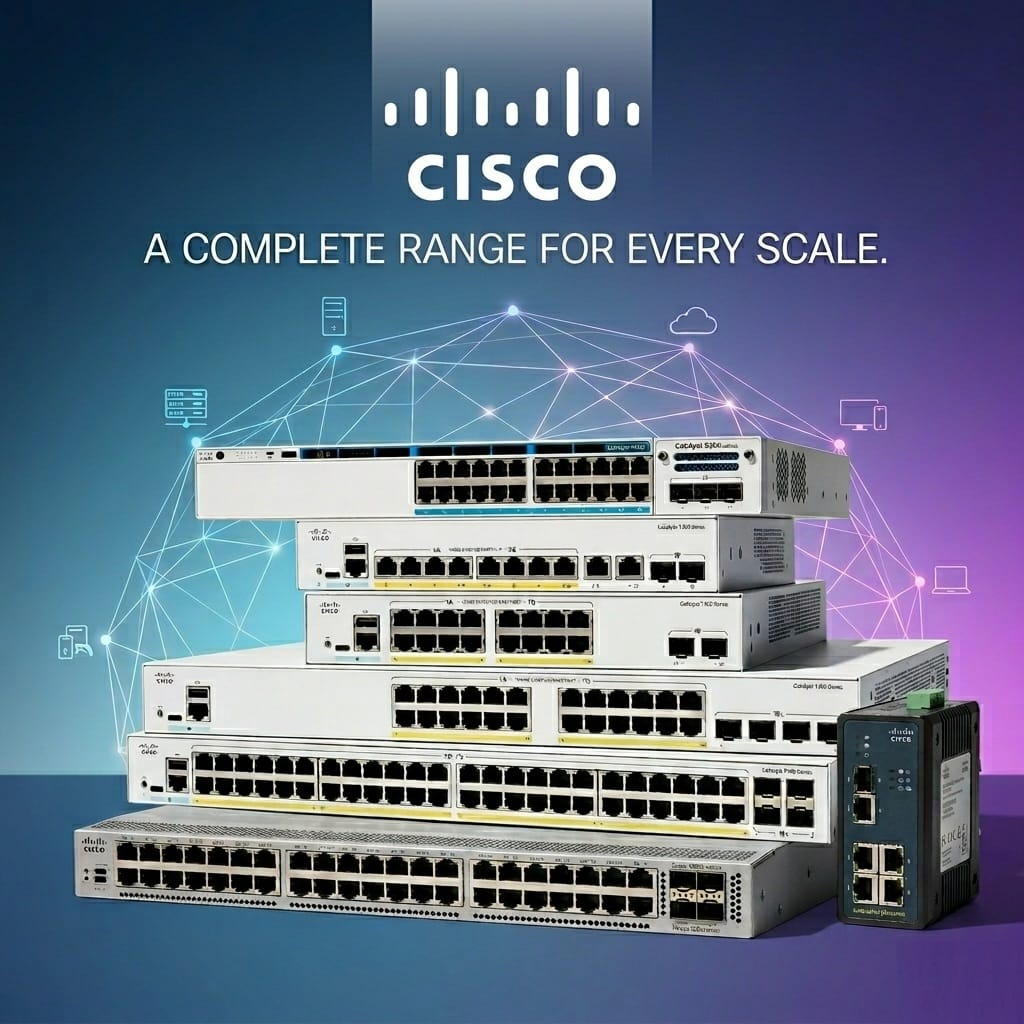
The Cisco C1200-48T-4G is a smart Layer 3, rack-mountable Gigabit Ethernet switch designed for dense access deployments. With 48 x 10/100/1000BASE-T copper ports and 4 x 1G SFP/SFP+ uplink slots, it blends wire-speed performance, resilient management, and rich QoS and security controls in a compact 1U form factor.
### Main Product Facts
? Manufacturer: Cisco
? Part Number / SKU: C1200-48T-4G
? Device Type: Managed L3 Switch (Smart)
? Enclosure: 19-inch rack-mountable, 1U
? Port Mix: 48 x 10/100/1000BASE-T + 4 x 1G SFP/SFP+
? Media Support: Twisted Pair & Optical Fiber
? Power Consumption (typ.): 48.64 W
## Performance & Switching Fabric
? Switching Capacity: 104 Gbps non-blocking fabric for high-throughput access layers
? Forwarding Rate (64-byte): up to 77.38 Mpps for deterministic forwarding
? Jumbo Frames: 9,000 bytes to optimize data-intensive transfers and backups
? Packet Buffer: 3 MB to absorb microbursts and smooth traffic
? MAC Address Table: 8,000 entries to scale with growing networks
### Layer 3 Intelligence & Routing Support
? Routing: Static IPv4/IPv6 routes for gateway consolidation and inter-VLAN connectivity
? Spanning-Tree Variants: STP, RSTP, MSTP, PVST+, and Rapid PVST+ to maintain loop-free topologies
? Multicast: IGMP, IGMPv2, IGMPv3, IGMP snooping and querier, MLD/MLDv2 for efficient streaming
? Addressing: CIDR awareness for flexible subnet design
? Dual-Stack: Native IPv4 and IPv6 operation for modern networks
### Scalable Capacity for Segmentation
? Active VLANs: up to 255 to segment users, devices, and services
? ACL Entries: 512 rules to enforce policy at the edge
? Priority Queues: 8 hardware queues per port for granular traffic handling
? STP Instances: MSTP (8), PVST+ (126), Rapid PVST+ (126) for per-VLAN control
? Link Aggregation: 4 LAG groups / 8 member ports for higher uplink bandwidth and resiliency
? IPv4 Resources: 32 static routes, 16 Layer-3 interfaces for compact routing scenarios
? IGMP Groups: 255 to support IPTV and collaboration platforms
## Traffic Engineering, QoS & Application Experience
? Classification & Marking: CoS, DSCP, ToS with DiffServ support for policy-based control
? Queueing: Strict Priority (SP) and Weighted Round Robin (WRR/Weighted) for deterministic delivery
? Rate Management: ingress rate limiting to temper chatty endpoints
? Voice & Video: Voice VLAN, Auto-Surveillance VLAN, VSDP for plug-and-play AV and IP phones
? Storm Control: broadcast, multicast, unknown-unicast protection to shield the LAN from floods
? TCP/UDP Optimizations: congestion controls and proxying features to stabilize flows
### Security, Trust & Resilience
? Port Security: MAC locking and violation actions to secure the edge
? 802.1X Access Control: RADIUS authentication with dynamic policies
? Encryption: SSL/HTTPS for secure management sessions
? Integrity & Hardening: Boot integrity, chip guard, trustworthy systems posture
? Threat Mitigation: DoS protection, loopback detection, STP loop guard, HOL-blocking prevention
? Segmentation: VLAN tagging, port-based VLANs, VLAN mirroring for audit and isolation
## Flexible Management & Automation
? Interfaces: CLI (console RJ-45 & USB-C), HTTP/HTTPS, Telnet/SSH/SSH-2 for choice-driven operations
? Telemetry: SNMP v2c/v3, RMON, Syslog, SNMP traps for monitoring and alerting
? IP Services: DHCP client/server/relay, DNS client, ICMP for robust network services
? Zero-Touch: streamlined deployment and remote firmware upgrades to reduce truck rolls
? Discovery: LLDP/LLDP-MED and CDP for neighbor visibility and fast provisioning
? Troubleshooting: cable diagnostics, cable length detection, port mirroring, VLAN mirroring
? Timekeeping: SNTP support to maintain log accuracy
### Green IT & Operational Efficiency
? EEE (Energy Efficient Ethernet): power savings during low utilization
? Eco-friendly Mode: dedicated hardware button to optimize consumption
? Intelligent Cooling: single-fan design balancing acoustics and reliability
## Interfaces, Uplinks & Expansion
? Access Ports: 48 x 1000BASE-T RJ-45 for desktops, phones, and APs
? Uplinks: 4 x 1G SFP/SFP+ for fiber aggregation or distribution connectivity
? Management Ports: 1 x RJ-45 console and 1 x USB-C console for out-of-band access
### Hardware Platform
? Processor: ARM-based CPU at 1.4 GHz for responsive control-plane operations
? Memory: 1 GB DDR4 SDRAM and 512 MB flash for images, configs, and logs
? Status LEDs: system and link/activity/speed indicators for at-a-glance health checks
## Power Architecture
? Internal PSU: AC 100?240 V, 50/60 Hz universal input for global deployments
? Typical Draw: approximately 48.64 W, aiding dense rack designs
? Form Factor: 1U rack-mountable to maximize space efficiency
### Standards Compliance
? Ethernet & PHY: IEEE 802.3, 802.3u, 802.3ab, 802.3z, 802.3x flow control, 802.3az EEE
? Bridging & VLANs: IEEE 802.1D, 802.1W, 802.1S, 802.1Q, 802.1p
? Aggregation & Discovery: IEEE 802.3ad (LACP), IEEE 802.1AB (LLDP)
? Security: IEEE 802.1X for port-based network access control
## Remote Management & Protocol Suite
? Control & Access: CLI, Telnet, SSH/SSH-2, HTTP/HTTPS
? Services: DHCP, ICMP, TFTP/SCP for image and config distribution
? Observability: SNMP v2c/v3, RMON groups, Syslog for event correlation
? Compatibility: seamless operation with Cisco and multivendor environments
### Use-Case Highlights
? Campus Access: high-density Gigabit edge with SFP uplinks into distribution/cores
? Branch Modernization: static routing and VLAN segmentation without a separate router
? Media & Collaboration: multicast-aware design for IPTV, signage, and conferencing
? IoT & Facilities: Auto-Surveillance VLAN, storm control, and diagnostics for resilient OT networks
## Advanced Features at a Glance
? VLAN Toolkit: port-based VLANs, tag-based VLANs, VLAN management, guest VLAN, voice VLAN
? Aggregation: LACP/LAG and port grouping to scale bandwidth and add redundancy
? Policy & Filtering: ACLs, DSCP-based CoS, ingress policing, WRR queuing
? Protection: DoS attack prevention, unknown-unicast/multicast/broadcast storm controls
? Diagnostics: port and VLAN mirroring, cable tests, loop detection, HOL blocking prevention
? Automation: zero-touch deployment with remote firmware upgrade and templated onboarding
### Media & Physical Layer Support
? Twisted Pair: 10/100/1000BASE-T auto-negotiation for copper endpoints
? Fiber: SFP/SFP+ bays for single-mode or multi-mode transceivers (1G)
? Path MTU Discovery: optimized forwarding across varied links
## Administrative Enhancements
? AAA & Identity: RADIUS for centralized authentication and authorization
? File & Image Control: TFTP/SCP for safe transfers and scheduled updates
? Time-Based Operations: calendar-driven policies for ports and services
? Client Utilities: Telnet client/server and reset button for recovery scenarios
### Key Metrics Recap
? 104 Gbps switching fabric with 77.38 Mpps forwarding
? 255 VLANs, 512 ACLs, 8 priority queues, 3 MB buffer
? 32 IPv4 static routes, 16 interfaces, 255 IGMP groups
? 8 MSTP instances, 126 PVST+, 126 Rapid PVST+
#### Hardware Interfaces Summary
? 48 x 10/100/1000BASE-T RJ-45 user ports
? 4 x 1G SFP/SFP+ uplinks for fiber expansion
? 1 x RJ-45 console and 1 x USB-C console for management
##### SKU & Identification
? Model: Cisco Catalyst 1200-48T-4G
? SKU: C1200-48T-4G
? Subtype: Gigabit Ethernet, modular SFP uplinks
## Cisco C1200-48T-4G Catalyst Ethernet Switch ? Category Overview
The Cisco C1200-48T-4G Catalyst Ethernet Switch represents a flexible, enterprise-ready access-layer platform designed for dense Gigabit Ethernet aggregation across modern LANs. With 48 auto-negotiating 10/100/1000BASE-T ports, four 1G SFP uplink slots (1000BASE-X), Layer 3 support, and a compact 1U rack-mountable chassis, this switch balances performance, manageability, and energy efficiency. It supports both twisted pair copper and optical fiber media, enabling organizations to extend reach, improve backbone resilience, and standardize on a unified access switching footprint. Tailored for wired campus, branch, hospitality, healthcare, education, retail, and SMB networks, the C1200-48T-4G is engineered to simplify operations while delivering advanced policy enforcement, segmentation, and traffic visibility.
## Core Capabilities and Feature Set
### Port Density and Media Flexibility
? 48 x 10/100/1000BASE-T RJ-45 ports for client, device, and server connectivity.
? 4 x SFP uplinks (1000BASE-X) for fiber aggregation or high-quality copper transceivers.
? Auto-MDI/MDI-X and auto-negotiation streamline edge device onboarding.
? Support for optical fiber (via SFP modules) and twisted pair copper cabling.
? 1U rack-mountable enclosure conserves space in wiring closets and micro-data centers.
### Layer 2 and Layer 3 Operations
As a Layer 3 supported modular access switch, the platform handles VLAN segmentation, inter-VLAN routing, static routes, dynamic gateway operations, and policy-based forwarding. At Layer 2, it delivers loop prevention, link aggregation, and granular QoS marking, ensuring deterministic performance even in dense, converged environments.
### Administrative Control and Manageability
? Enterprise-grade CLI, secure web UI, and SNMP integration for streamlined operations.
? Role-based access controls with AAA/RADIUS/TACACS+ for admin governance.
? Configuration templates, zero-touch provisioning options, and file-based backups.
? Power-aware design with typical 48.64 W power consumption (model-dependent) for energy savings.
## Hardware Architecture and Design
### Mechanical and Thermal Considerations
The fan-assisted chassis is optimized for wiring-closet deployments, balancing airflow, acoustics, and component longevity. With a fixed, low-profile design, the switch fits standard 19-inch racks, offering clean cable management with front-facing ports, visible port status LEDs, and clearly labeled SFP uplinks.
### Power Efficiency Profile
Power draw near 48.64 W under typical loads (without PoE provisioning) keeps operational expenditure low. Advanced silicon supports dynamic power scaling, while Energy Efficient Ethernet (EEE) can downshift link power during idle periods, reducing heat and minimizing cooling requirements.
### Connectivity Mix and Cabling
? Twisted pair copper for short-to-medium distances with 100-meter reach per segment.
? Optical fiber via SFPs for long-distance uplinks, EMI immunity, and backbone diversity.
? Standards-compliant 1000BASE-T and 1000BASE-X interoperability across heterogeneous networks.
## Performance and Switching Fabric
### Throughput, Latency, and Buffers
Wire-speed switching across all 48 copper ports ensures deterministic forwarding under heavy east-west traffic. Deep packet buffers mitigate microbursts common in virtualization, backup windows, and high-fan-in traffic patterns. ASIC-accelerated features maintain low latency for voice, video, and latency-sensitive telemetry.
### Link Aggregation and Redundancy
? IEEE 802.3ad/Link Aggregation Control Protocol (LACP) for multi-link bundles toward upstream distribution/core.
? Fast convergence with Rapid Spanning Tree (RSTP) and Multiple Spanning Tree (MST).
? UDLD/loop guard to protect against unidirectional faults and accidental layer-2 loops.
### Resilient Uplinks with SFP Modules
The 4 SFP slots allow flexible uplink strategies: dual-homed connectivity to redundant distribution switches, dedicated fiber rings between closets, or segmented uplinks for traffic isolation (e.g., corporate vs. guest). With hot-swappable SFPs, upgrades from short-reach (SX) to long-reach (LX/EX) optics can happen without downtime.
## Layer 3 Feature Depth
### Inter-VLAN Routing and Segmentation
Virtual interfaces (SVIs) make the switch a compact Layer 3 gateway for each VLAN, simplifying routing at the access layer. This reduces hairpin traffic to the core and lowers latency for local east-west communications. Static routes and policy-based rules allow traffic steering to firewalls, WAN edges, or SD-WAN appliances.
### Dynamic Routing Options (Model-Dependent)
? Support for dynamic protocols (availability varies by license/model) such as RIP or OSPF for automated route exchange.
? Equal-cost multipath (ECMP) for improved path diversity on suitable topologies.
? VRF-Lite-style segmentation (where supported) for tenant or department isolation.
### First-Hop Redundancy and Gateway Resilience
Industry-standard first-hop redundancy (e.g., HSRP/VRRP/GLBP?where supported) allows multiple Layer 3 devices to present a single virtual default gateway. Client subnets retain continuity during failover events, planned maintenance, or distribution-layer upgrades.
## Security, Access Control, and Policy Enforcement
### Edge Security Controls
? 802.1X port-based authentication with MAB fallback for non-supplicant devices.
? Dynamic VLAN assignment and downloadable ACLs through RADIUS for per-user policy.
? DHCP snooping to prevent rogue servers; IP source guard to mitigate spoofing.
? Dynamic ARP inspection to block ARP poisoning and man-in-the-middle attempts.
? Storm control and port security to cap broadcast/multicast/unknown unicast events and limit MAC address table abuse.
### Segmentation for Compliance
VLANs and access control lists help enforce separation between payment systems, guest networks, operational technology (OT), and administrative segments. When combined with Layer 3 gateway features, policy enforcement becomes simpler to reason about and easier to audit.
### Management Plane Protection
? SSH/HTTPS for encrypted administration.
? RADIUS/TACACS+ for identity-aware command authorization and accounting.
? Control-plane policing, secure SNMPv3, and logging to SIEMs for continuous monitoring.
## Quality of Service (QoS) for Converged Networks
### Classification and Marking
Ingress classification based on CoS/DSCP, access-lists, and L4 details enables precise mapping of business-critical applications to priority queues. The switch can trust markings from IP phones and thin clients, or remark traffic at the edge to enforce a consistent QoS domain.
### Scheduling and Congestion Management
? Priority queuing for voice and interactive video.
? Weighted scheduling for fair bandwidth distribution across classes.
? Tail drop or weighted tail drop strategies to preserve quality under congestion.
### End-to-End Experience
QoS policies propagate from access to distribution to data center, ensuring consistent performance for UCaaS, VDI, POS, ERP, and real-time analytics. Application classification can be aligned with business SLAs and compliance priorities.
## Operations, Monitoring, and Lifecycle Management
### Provisioning and Configuration
? Bootstrapping through DHCP options and file servers for rapid turn-ups.
? Templated CLI/Ansible automation to standardize VLANs, ACLs, and QoS.
? Golden configuration baselines with change control and rollback plans.
### Telemetry and Visibility
? SNMP MIB coverage for interface counters, environmental data, and events.
? Syslog export to centralized logging for correlation and alerting.
? NetFlow/sFlow-style traffic visibility (where supported) for capacity planning.
? RMON and event notifications to identify threshold breaches early.
### Software Maintenance
Modular software updates, staged maintenance windows, and dual-image strategies (model-dependent) help minimize downtime. Signed image verification and controlled upgrade workflows ensure network integrity and compliance with security policies.
## Deployment Scenarios and Use Cases
### Enterprise Access Layer
Deploy multiple C1200-48T-4G units in each floor closet to aggregate workstations, thin clients, wireless AP backhaul (via copper links to PoE switches if needed), IP phones, security devices, and printers. Use VLAN assignments per department, with local inter-VLAN routing to enable efficient east-west traffic while retaining clear policy boundaries.
### Branch and Remote Office
For mid-sized branch sites, the switch functions as the central access platform, uplinking over fiber to a WAN edge or SD-WAN gateway. Traffic steering and ACLs constrain guest, IoT, and corporate segments. Static routes or lightweight dynamic routing keep the design simple yet resilient.
### Retail and Hospitality
Leverage VLANs for POS, guest Wi-Fi backhaul, security cameras, and corporate LAN. SFP uplinks provide fiber runs to MDFs, reducing electromagnetic interference concerns in kitchens, industrial coolers, or elevator shafts. QoS ensures voice and payment transactions retain priority.
### Healthcare and Education
Segment clinical systems, research devices, student networks, and administrative IT using a mix of 802.1X enforcement and downloadable ACLs. The switch?s Layer 3 support and monitoring features help meet compliance and privacy requirements while scaling to large numbers of endpoints.
## Design Blueprint and Best Practices
### Access?Distribution?Core Hierarchy
Build a balanced three-tier campus: aggregate multiple access closets to dual distribution switches using the C1200?s 4 x SFP uplinks for redundant paths. Maintain MST instances per building or per campus area, and apply LACP bundles for high-availability toward upstream layers.
### VLAN and Subnet Planning
? Allocate VLANs by function (voice, data, guest, IoT) with non-overlapping IP ranges.
? Summarize routes at distribution to shrink core routing tables.
? Use private VLANs (where available) to isolate east-west chatter in sensitive zones.
### Edge Security and Identity
? Deploy 802.1X with device profiling; use MAB for legacy devices.
? Bind critical ports to known MAC addresses and limit MAC table entries.
? Enable DHCP snooping, IP source guard, and DAI on client VLANs.
### QoS Policy Template
? Trust phone DSCP; remark softphones at ingress if inconsistent.
? Reserve a strict priority queue for voice; allocate bandwidth to video and critical apps.
? Rate-limit best-effort bulk traffic to prevent starvation of interactive services.
### High-Availability Uplink Patterns
Create two LACP port-channels from the access switch?one to each distribution switch?using SFP fiber. Configure first-hop redundancy for SVIs across the upstream pair. Test failovers during pre-production to validate timers, convergence, and application response times.
## Media, Optics, and Cabling Guidance
### Twisted Pair (Copper) Considerations
? Use Cat6/Cat6A for 1 Gbps runs to 100 meters; ensure proper termination practices.
? Leverage shielded cabling where EMI is prevalent (industrial floors, heavy machinery).
? Label both ends of every cable and maintain patch panel hygiene to reduce MTTR.
### Optical Fiber with SFP Transceivers
? Short-reach multimode (SX) for intra-building uplinks.
? Long-reach single-mode (LX/EX) for campus inter-connects or distant IDFs.
? Consider bidirectional optics or CWDM/DWDM in fiber-scarce environments.
### Redundancy via Diverse Paths
Where possible, terminate SFP uplinks on physically diverse risers. Separate power circuits and route fibers through independent conduits to reduce correlated failure risk during utility events or maintenance activities.
## Management, Automation, and Telemetry
### Configuration Workflows
? Adopt infrastructure-as-code with version-controlled templates for VLANs, ACLs, QoS, and SVIs.
? Perform linting and pre-deployment validation in a test environment.
? Use configuration locks and change windows for coordinated rollouts across multiple closets.
### Observability and Alerting
? Export SNMP metrics to NMS platforms; baseline interface utilization per closet.
? Forward syslog to SIEM with severity filters; alert on link flaps and authentication anomalies.
? Capture flow records (where supported) to identify top talkers and anomalous patterns.
### Capacity Planning
Monitor uplink utilization from each access stack. If 1 Gbps SFPs approach saturation, consider additional aggregated links or staged migration toward higher-rate uplinks in distribution (subject to ecosystem support). Track endpoint growth, VLAN sprawl, and ACL complexity to maintain predictable performance.
## Security Hardening Checklist
### Identity and Access Management
? Enable AAA with TACACS+/RADIUS for per-command authorization and accounting.
? Restrict management access to trusted subnets; disable legacy protocols.
? Rotate keys and certificates; audit admin roles regularly.
### Data Plane Protections
? ACLs at SVI interfaces to constrain lateral movement.
? Storm control thresholds tuned to environment; enable BPDU guard on edge ports.
? ARP inspection and source guard on user VLANs; secure trunk negotiations.
### Logging and Forensics
Mirror suspicious ports to an analysis sensor when indicators of compromise emerge. Maintain time synchronization for accurate event correlation. Store configuration snapshots in an encrypted repository with clear change history.
## Energy Efficiency and Sustainability
### Low Power Consumption Profile
Typical 48.64 W draw reduces operating costs across large deployments. EEE and intelligent port power states curtail consumption during idle windows such as nights, weekends, or seasonal down-time. Lower heat output can translate into fewer fan tray replacements and improved component longevity.
### Smart Cooling and Airflow
? Front-to-back airflow aligns with hot-aisle/cold-aisle designs.
? Maintain clear intake paths and appropriate rack spacing to avoid thermal hotspots.
? Use environmental sensors to correlate temperature spikes with load or obstruction.
## Lifecycle, Warranty, and Spares Strategy
### Standardization Advantages
Standardizing on the C1200-48T-4G at the access layer simplifies training, spares, and configuration templates. Uniform software images and consistent port layouts reduce the likelihood of operational errors and speed up troubleshooting.
### Spares and RMA Planning
? Keep at least one spare chassis per building or per region for rapid swap-outs.
? Stock a small library of SFP modules (SX and LX) for field replacements.
? Document serials, inventory locations, and last-known configuration states.
## Comparison Within the Category
### Why 48 x 1G Access with 1G Fiber Uplinks?
Many organizations prioritize widespread Gigabit to the desktop while reserving higher-rate links for distribution and core. The 48 x 1G + 4 x 1G SFP model hits a price-performance sweet spot for wired campus access without the expense of ubiquitous multi-gig or 10G at the edge. It also delivers operational predictability with proven optics and copper transceivers.
### When to Choose Multi-Gig or PoE Models
Workloads with heavy Wi-Fi 6/6E AP backhaul, high-density VDI, or creative media production may benefit from multi-gig access or PoE-capable variants to power phones and APs directly. The C1200-48T-4G is ideal where power delivery is not required at the switch (e.g., devices powered by adapters, PoE provided elsewhere, or non-PoE environments).
### Scalability and Modularity
Modular uplink design with 4 SFP slots enables incremental growth?add links, add fibers, or split traffic classes without replacing the chassis. This protects capital investment as user counts and application patterns evolve.
## Frequently Deployed Configurations
### Secure Campus Access Stack
? 802.1X with user/device assignments to per-department VLANs.
? Downloadable ACLs from RADIUS for contextual policy at the edge.
? HSRP/VRRP default gateway redundancy on distribution.
? LACP uplinks across diverse fiber paths to aggregation.
? QoS queues tuned for voice, video, and mission-critical applications.
### Retail Multi-Segment Layout
? Separate VLANs for POS, cameras, staff devices, guests, and IoT sensors.
? ACLs restricting POS to payment processors; micro-segmentation for IoT.
? NetFlow-style visibility (where supported) to track top talkers and anomalies.
? Syslog to SIEM with alerting on MAC flaps, authentication failures, and DHCP anomalies.
### Education and Lab
? Per-lab VLANs with SVI gateways on the C1200-48T-4G.
? Rate limits for bulk traffic; priority for interactive learning tools and voice.
? Guest isolation with ACLs and captive portals upstream.
## Implementation Steps and Validation
### Pre-Deployment
? Inventory optics, cables, and rack space; validate power budget and UPS autonomy.
? Define VLAN/IP schema, ACL policy, and QoS classes.
? Stage the switch with base config, credentials, and SNMP/Syslog endpoints.
### Cutover
? Label patch cords; migrate users in batches to reduce blast radius.
? Verify SFP link integrity and LACP bundle health.
? Confirm DHCP snooping bindings and 802.1X authentications.
### Post-Deployment
? Baseline bandwidth per uplink and per VLAN.
? Enable threshold alerts for CPU, memory, interface errors, and temperature.
? Schedule routine config backups and compliance checks.
## Troubleshooting Strategies
### Link-Layer Issues
? Check interface counters for errors, CRCs, late collisions (legacy), or flaps.
? Verify cabling grade and length; test with certified cable analyzers when needed.
? Ensure auto-negotiation alignment; hard-set speed/duplex only for legacy endpoints.
### Authentication and Access
? Analyze 802.1X logs; confirm RADIUS reachability and certificate validity.
? Use MAB for non-supplicants and map them to restricted VLANs.
? Cross-check DHCP snooping bindings if IP source guard blocks traffic.
### Routing and Policy
? Verify SVI status and HSRP/VRRP roles; inspect ARP tables for anomalies.
? Trace ACL hit counts to confirm expected policy enforcement.
? Check default routes and upstream reachability with path testing tools.
## Compliance, Auditing, and Governance
### Policy-Driven Networking
Align VLAN design and ACLs with regulatory frameworks like PCI DSS, HIPAA, or FERPA. Document who can change what, when, and how, and prove changes through AAA logs and configuration diffs. Use device inventory and software bill of materials to track vulnerability exposure.
### Change Control and Documentation
? Pre-approve maintenance windows; record intended changes and rollback plans.
? Archive pre- and post-change configs; note firmware revisions.
? Attach topology diagrams and port maps for each closet switch.
## Scalability Roadmap and Future-Proofing
### From Single Closet to Campus-Wide
Start with one C1200-48T-4G in a small closet, then expand laterally by adding more units per floor as demand grows. Use the 1G SFP uplinks to stitch floors and buildings with resilient fiber rings or redundant star topologies. Introduce distribution switches with higher-rate uplinks as aggregation requirements increase.
### Migration Paths
? Introduce PoE access switches alongside the C1200 where powered endpoints proliferate.
? Adopt multi-gig access selectively for high-throughput teams or AP backhaul.
? Phase in enhanced routing features at distribution while preserving access simplicity.
## Technical Specifications at a Glance
### Interface Summary
? 48 x 10/100/1000BASE-T RJ-45 ports.
? 4 x 1G SFP uplink slots supporting 1000BASE-X optics.
? Media support for optical fiber (via SFP modules) and twisted pair copper.
### Switching and Routing
? Layer 2 switching with VLANs, MST/RSTP, and LACP.
? Layer 3 supported: SVIs, static routing, and select dynamic protocols (model/license dependent).
? QoS with classification, marking, and priority queuing for real-time traffic.
### Power and Form Factor
? Typical 48.64 W power consumption (non-PoE scenario).
? 1U rack-mountable metal chassis with front-facing interfaces.
? Fan-assisted cooling with environmental monitoring.
### Security and Management
? 802.1X, MAB, DHCP snooping, IP source guard, dynamic ARP inspection.
? ACLs on routed interfaces and port security on access ports.
? SSH/HTTPS management, SNMPv3, Syslog, AAA with RADIUS/TACACS+.
## Operational Tips for Dense 48-Port Environments
### Cable Management and Labeling
? Adopt color-coded patch leads per VLAN or security zone.
? Keep service loops short; avoid tight bends and overcrowded ducts.
? Document port-to-jack mappings and update diagrams after every change.
### Port Profiles
? Create templates for user ports (802.1X, voice VLAN, storm control), trunk ports (allowed VLANs, native VLAN), and uplinks (LACP, trust boundaries).
? Apply consistent LLDP/LLDP-MED for endpoint discovery and voice device configuration.
### Monitoring Interface Health
? Track error rates and top talkers; alert on abnormal spike patterns.
? Watch for authentication failures and rogue device attachment attempts.
? Trend power and temperature to preempt fan or PSU issues.
## Real-World Outcomes and Value
### Reduced Complexity
A standardized 48-port Gigabit access design simplifies procurement, staging, and ongoing support. Administrators can maintain predictable configurations across many closets, cutting mean-time-to-repair and accelerating new-site rollouts.
### Improved Reliability
Redundant SFP uplinks, robust Layer 2 protections, and edge security controls lower the likelihood of outages due to loops, rogue DHCP servers, or misconfigurations. First-hop redundancy at the gateway level keeps user traffic flowing through maintenance windows and fault events.
### Optimized TCO
With modest 48.64 W typical consumption and a durable 1U form factor, the C1200-48T-4G helps organizations balance capital costs with ongoing energy and cooling savings. Multi-year standardization further reduces training and operational overhead.
## SEO-Focused Keyword Clusters
### Primary Keywords
? Cisco C1200-48T-4G switch
? 48-port Gigabit Ethernet switch
? Layer 3 managed Ethernet switch
? 1U rack-mountable network switch
? 4 SFP 1000BASE-X uplinks
### Secondary Keywords
? 10/100/1000BASE-T managed switch
? optical fiber and twisted pair
? campus access layer switch
? VLAN inter-VLAN routing
? QoS for voice and video
### Long-Tail Phrases
? best Layer 3 48 port Gigabit switch for enterprise
? Cisco Catalyst manageable switch with SFP uplinks
? energy efficient 1U rack-mountable Ethernet switch
? secure network access with 802.1X and ACLs
? scalable access layer design with fiber uplinks
## Sample Configuration Patterns
### Template Concepts (Illustrative)
? Create VLANs for voice, data, guest, and IoT with distinct subnets.
? Enable 802.1X on access ports, with MAB fallback and guest VLANs.
? Apply ACLs at SVI interfaces to restrict inter-segment traffic.
? Trust DSCP from IP phones and prioritize voice queues.
? Bundle SFP uplinks via LACP to dual distribution switches.
### Policy Examples
? Permit POS to payment gateways only; deny lateral to staff VLANs.
? Allow guest to Internet; block RFC1918 destinations internal to the enterprise.
? Rate-limit bulk backup traffic during business hours; prioritize conferencing apps.
## Capacity and Growth Planning
### Right-Sizing Access Density
Use a 24-to-48 port ratio per 40?60 workspaces and include a 20% growth buffer. For high-churn floors, prefer more 48-port units to avoid oversubscription and patching chaos. Track actual port utilization quarterly to re-balance closets.
### Uplink Headroom
Start with two fiber uplinks and expand to four if utilization routinely exceeds 60?70% during peaks. Use LACP hashing adjusted for your traffic profile (layer-3-based hashing for diverse flows) to achieve even distribution across member links.
### Service Assurance
Establish KPIs: uptime, convergence times, authentication success rates, queue occupancy, and jitter for voice/video. Tie NMS alerts to KPIs, and pre-define runbooks for common failures (uplink flap, excessive errors, authentication storms).
## Environmental and Physical Security
### Closet Hardening
? Lock racks and use surveillance in shared facilities.
? Ground racks and ensure surge protection where power quality is inconsistent.
? Fire suppression and temperature monitoring aligned with building standards.
### Labeling and Documentation Discipline
Every port, patch, and panel should map to a worksheet that lives alongside topology diagrams. Embed QR codes on racks linking to port maps and standard operating procedures for replacements or expansion.
## Why Standardize on Cisco C1200-48T-4G in This Category
### Consistent Operational Model
Uniform CLI, policy constructs, and monitoring approaches across sites reduce onboarding time for engineers and contractors. Documentation, training, and automation templates carry across regions and departments.
### Balanced Feature Mix
The combination of 48 x 1G copper, 4 x 1G SFP uplinks, Layer 3 support, robust security, and 1U rack-mountable ergonomics delivers the essentials for a modern access edge without unnecessary complexity. It fits right into hierarchical campus designs and sca